

Have you ever wondered how many creatures can be found from A to Z? Animals A to Z offers a fun way to explore more than 200 fascinating species from around the world. This guide brings together animal names ranging from familiar pets to unusual wildlife. You’ll discover mammals, birds, reptiles, amphibians, fish, insects, and marine creatures in one easy-to-follow resource. Each section highlights interesting details about an animal’s habitat, diet, and classification.
Whether you’re a student, parent, teacher, or curious wildlife lover, this A–Z journey makes learning about the animal kingdom simple and enjoyable. Get ready to meet remarkable creatures from every letter.
A–Z Animals at a Glance
The table below gives you a quick look at one animal representing each letter. It also shows the animal group and its typical habitat.
| Letter | Example Animal | Animal Group | Habitat |
| A | Aardvark | Mammal | African savanna |
| B | Bear | Mammal | Forests |
| C | Cheetah | Mammal | Grasslands |
| D | Dolphin | Marine Mammal | Oceans |
| E | Elephant | Mammal | Grasslands and forests |
| F | Flamingo | Bird | Wetlands |
| G | Giraffe | Mammal | Savanna |
| H | Hippopotamus | Mammal | Rivers and wetlands |
| I | Iguana | Reptile | Tropical regions |
| J | Jaguar | Mammal | Rainforests |
| K | Kangaroo | Mammal | Australian grasslands |
| L | Lion | Mammal | Grasslands and savannas |
| M | Moose | Mammal | Northern forests |
| N | Narwhal | Marine Mammal | Arctic waters |
| O | Octopus | Mollusk | Oceans |
| P | Penguin | Bird | Coastal and polar regions |
| Q | Quokka | Mammal | Australia |
| R | Rhinoceros | Mammal | Grasslands |
| S | Shark | Fish | Oceans |
| T | Tiger | Mammal | Forests |
| U | Uakari | Primate | Amazon Basin |
| V | Vulture | Bird | Open landscapes |
| W | Walrus | Marine Mammal | Arctic waters |
| X | X-ray Tetra | Fish | Freshwater |
| Y | Yak | Mammal | Mountains |
| Z | Zebra | Mammal | African grasslands |
Animals That Start With A
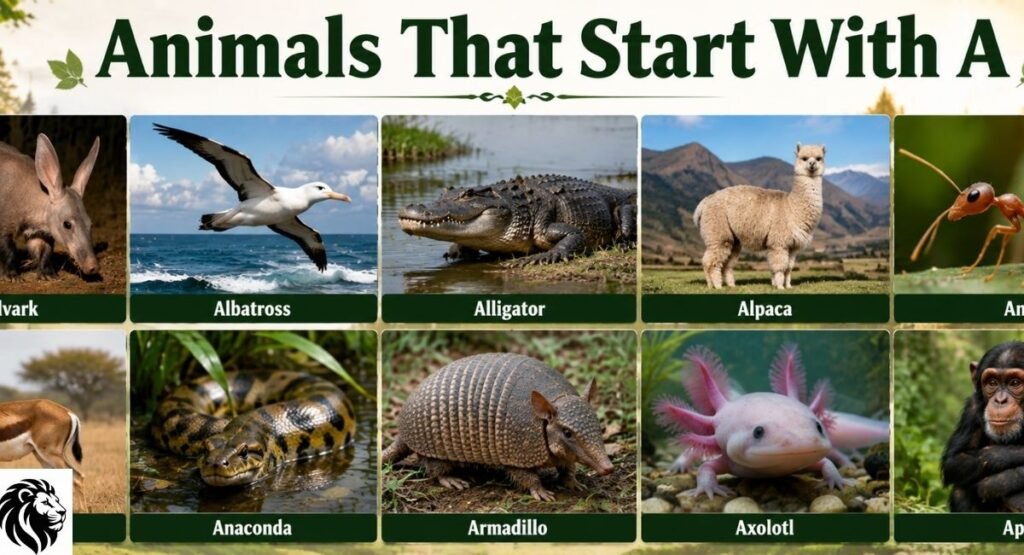
The letter A offers an exciting mixture of mammals, birds, reptiles, insects, and amphibians. Some are common, while others are unusual. Here are useful animal names starting with A and facts that make each one interesting.
Aardvark
The aardvark is a nocturnal mammal native to sub-Saharan Africa. It has a long snout, large ears, powerful claws, and a sticky tongue. Its main food consists of ants and termites. Aardvarks often dig burrows that later provide shelter for other animals.
Albatross
The albatross is a large seabird famous for its enormous wingspan and efficient flying ability. It spends much of its life over the open ocean. Its long, narrow wings allow it to glide across ocean winds while using relatively little energy.
Alligator
The alligator is a large reptile associated with freshwater wetlands, swamps, rivers, and lakes. The American alligator is especially common in the southeastern United States. It has powerful jaws and spends considerable time in water while hunting fish, reptiles, birds, and other prey.
Alpaca
The alpaca is a domesticated mammal related to llamas and other camelids. It originated in South America and is valued for its soft fiber. Alpacas mainly eat grasses and other vegetation. Their thick coats help them handle cool conditions in high-altitude environments.
Ant
Ants are social insects that usually live in organized colonies. Different species create nests underground, inside wood, or among plants. They can carry food, defend their colonies, and communicate using chemical signals. Ants also help ecosystems by moving soil and recycling organic material.
Antelope
Antelope is a broad term used for many hoofed mammals found mainly in Africa and parts of Eurasia. Many species have slender bodies and strong legs built for running. They usually eat grasses, leaves, shoots, or other vegetation depending on the species.
Anaconda
Anacondas are large constricting snakes native to South America. Green anacondas are particularly famous for their impressive size. They often live around rivers, swamps, and other wetlands. Their powerful bodies allow them to capture and restrain prey before swallowing it.
Armadillo
The armadillo is a distinctive mammal recognized by its protective bony plates. Several species live throughout the Americas. The nine-banded armadillo is especially familiar in parts of the southern United States. Armadillos use their strong claws to dig for insects and other food.
Axolotl
The axolotl is an unusual amphibian native to Mexico. Unlike many amphibians, it can retain juvenile features throughout adulthood. It has external gills and remarkable regenerative abilities. Scientists have studied axolotls extensively because of their ability to regenerate certain tissues and body parts.
Ape
Apes are primates that include chimpanzees, gorillas, orangutans, gibbons, and humans. They generally have flexible shoulders and relatively large brains. Many apes display complex social behavior, communication, learning, and problem-solving abilities.
Animals That Start With B
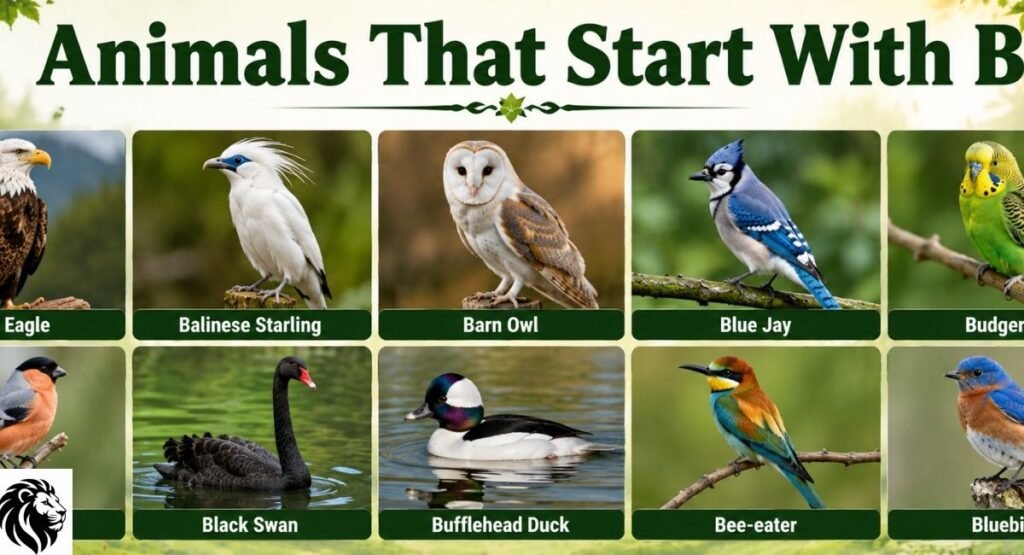
B contains several familiar animal names, including large mammals, flying mammals, birds, insects, and marine giants. These animals demonstrate how much diversity can exist under one letter.
Baboon
Baboons are social primates native mainly to Africa and parts of the Arabian Peninsula. They live in groups that can contain many individuals. Their diets include fruits, seeds, grasses, insects, and other foods. Their strong social relationships help them survive in challenging environments.
Badger
Badgers are sturdy mammals known for their powerful claws and digging ability. Different badger species occupy different habitats across North America, Europe, and Asia. They may eat insects, small animals, roots, fruits, and other available foods.
Bat
Bats are the only mammals capable of sustained powered flight. Many species use echolocation to navigate and locate prey in darkness. Some bats eat insects, while others feed on fruit, nectar, or other foods.
Bear
Bears are large mammals found across parts of North America, Europe, and Asia. Different species occupy forests, mountains, tundra, and other habitats. Many bears are omnivorous and eat a mixture of plants, insects, fish, and other foods.
Beaver
Beavers are large rodents famous for building dams from branches, mud, and other materials. Their engineering changes waterways and creates wetland habitat. They have strong teeth, webbed feet, and flattened tails that help them live in aquatic environments.
Bison
Bison are large grazing mammals native to North America and Europe. American bison once occupied enormous areas of North America. They feed mainly on grasses and other vegetation. Today, conservation programs help protect wild populations.
Buffalo
The word buffalo can refer to several large bovines. In North America, it is often used informally for the American bison. True buffalo, such as the water buffalo, are native to parts of Asia and other regions.
Butterfly
Butterflies are insects known for their colorful wings and complex life cycle. They begin life as caterpillars before forming a chrysalis and emerging as adults. Adult butterflies often feed on nectar while helping pollinate many plants.
Blue Whale
The blue whale is the largest known animal on Earth. This enormous marine mammal lives throughout many of the world’s oceans. Despite its massive body, it mainly feeds on tiny krill by filtering large amounts of seawater through baleen plates.
Boa
Boas are nonvenomous constricting snakes found mainly in the Americas and some nearby regions. They use muscular bodies to restrain prey. Their diets can include rodents, birds, and other animals depending on the species.
Animals That Start With C
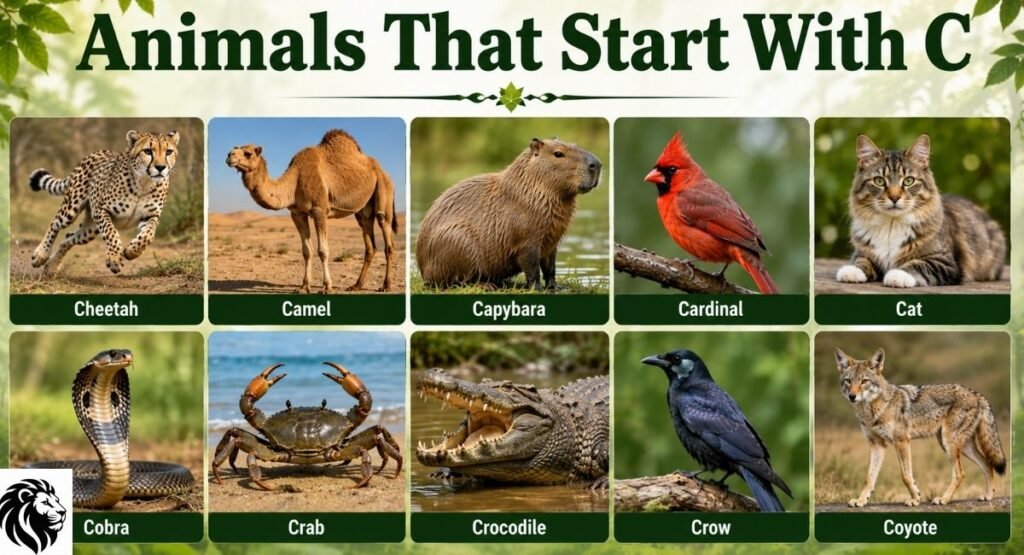
C provides many well-known animals starting with C, from household animals to powerful predators and marine creatures.
Camel
Camels are large mammals adapted to dry environments. Their bodies can handle challenging desert conditions, while their wide feet help them walk across loose sand. Camels eat vegetation and can travel considerable distances when searching for food and water.
Capybara
The capybara is the largest living rodent. It is native to South America and often lives near rivers, lakes, wetlands, and marshes. Capybaras are social animals and feed mainly on grasses and aquatic vegetation.
Caribou
Caribou are also known as reindeer in many regions. They are large hoofed mammals adapted to northern environments. Their diet includes lichens, grasses, leaves, and other vegetation. They can travel long distances during seasonal movements.
Cat
Domestic cats are small carnivorous mammals that have lived alongside humans for thousands of years. They retain strong hunting instincts and excellent hearing. Cats use their flexible bodies, sharp claws, and keen senses to catch small prey.
Cheetah
The cheetah is a specialized African predator famous for short bursts of speed. Its lightweight body, long legs, flexible spine, and large nasal passages support rapid movement. Cheetahs usually hunt smaller and medium-sized hoofed animals.
Chicken
Chickens are domesticated birds raised worldwide for eggs, meat, and other purposes. They belong to the pheasant family. Chickens communicate through many calls and can recognize individuals within their social groups.
Chimpanzee
Chimpanzees are highly intelligent great apes native to Africa. They live in complex social groups and use tools in some populations. Their diets include fruits, leaves, seeds, insects, and occasionally other animals.
Cobra
Cobras are venomous snakes found across parts of Africa and Asia. Several species can raise the front portion of their bodies when threatened. Their venom helps them subdue prey and can also serve as a powerful defense.
Crocodile
Crocodiles are large reptiles that live in tropical and subtropical regions. Many species inhabit rivers, lakes, wetlands, and coastal areas. Their powerful jaws allow them to capture fish, birds, mammals, and other animals.
Crab
Crabs are crustaceans found in marine, freshwater, and terrestrial environments. Their hard exoskeleton protects the body, while their claws can help with feeding and defense. Some species live along beaches, while others inhabit deep ocean environments.
Animals That Start With D
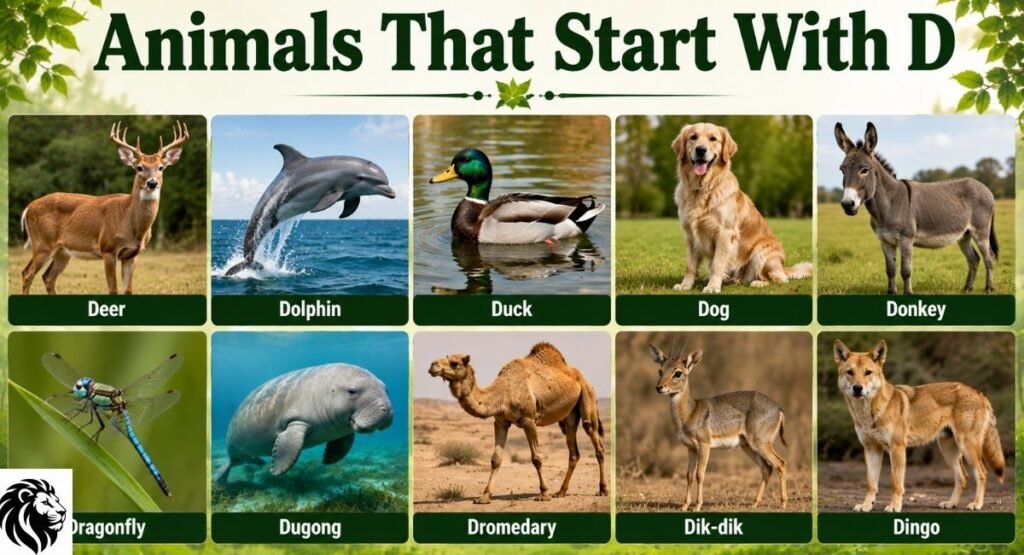
D includes mammals, birds, insects, and aquatic creatures. Some are closely connected with humans, while others live almost entirely in the wild.
Deer
Deer are hoofed mammals found across many parts of the world. They generally feed on leaves, grasses, fruits, and other vegetation. Many species have antlers, although antler growth and presence vary among deer species.
Dingo
The dingo is a wild canid associated strongly with Australia. It lives in diverse habitats, including deserts, grasslands, forests, and coastal regions. Dingoes hunt a variety of animals and can also consume fruit or other available foods.
Dog
Dogs are domesticated mammals that have lived with humans for thousands of years. Selective breeding has produced enormous variety in their size, shape, behavior, and purpose. Dogs can serve as companions, working animals, herders, and assistance animals.
Dolphin
Dolphins are intelligent marine mammals found in oceans and some rivers. They use sound for communication and echolocation. Many species live in social groups and cooperate during feeding, travel, and protection.
Donkey
Donkeys are domesticated members of the horse family. They are known for endurance and their ability to carry loads across difficult terrain. Donkeys mainly eat grasses and other vegetation.
Dragonfly
Dragonflies are flying insects recognized by long bodies, large eyes, and two pairs of transparent wings. They are skilled aerial hunters that capture insects during flight. Their young develop in water before becoming adults.
Dugong
The dugong is a marine mammal closely related to the manatee. It lives in warm coastal waters and feeds mainly on seagrasses. Dugongs are especially dependent on healthy shallow-water ecosystems.
Duck
Ducks are waterfowl found in freshwater and marine environments. Many species have webbed feet and specialized bills for feeding. Their diets vary and can include plants, insects, small aquatic animals, and seeds.
Animals That Start With E
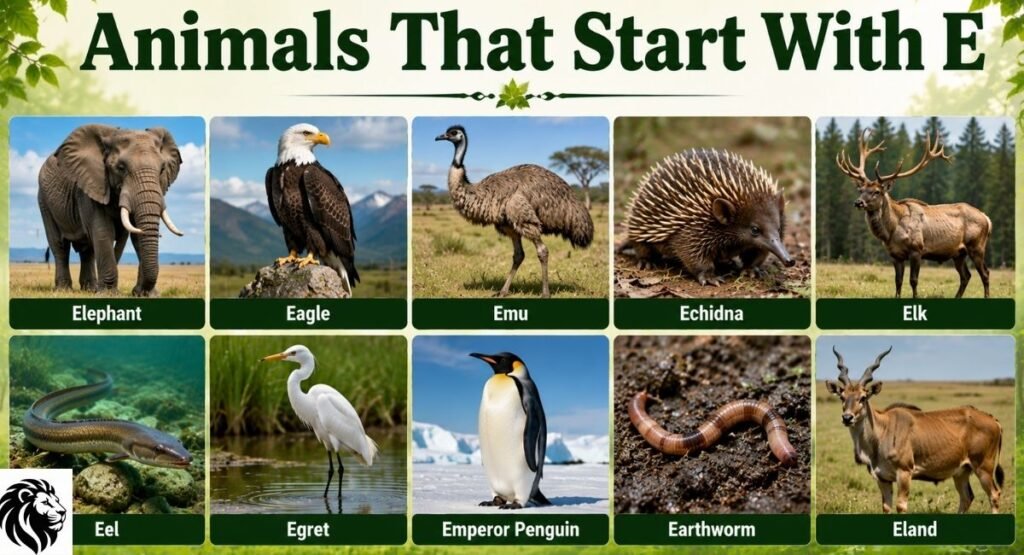
The E section contains huge mammals, birds, reptiles, and small invertebrates.
Eagle
Eagles are large birds of prey with powerful talons and hooked beaks. Many species have excellent eyesight that helps them locate prey. They live in habitats ranging from mountains and forests to coastal areas.
Eel
Eels are elongated fish with long bodies that resemble snakes. Different eel species live in marine or freshwater environments. Some migrate between different habitats during their life cycles.
Elephant
Elephants are the largest living land animals. They use their trunks for feeding, drinking, touching, and communication. Their large ears help release heat, while their social behavior includes strong family relationships.
Elk
Elk are large members of the deer family. They are native to North America and parts of Asia. They mainly eat grasses and other plants and often live in forests, meadows, and mountain environments.
Emu
The emu is a large flightless bird native to Australia. It has long legs and can run quickly across open landscapes. Emus eat plants, seeds, fruits, and insects.
Echidna
Echidnas are unusual egg-laying mammals found in Australia and New Guinea. They have spines, long snouts, and specialized tongues. They feed mainly on ants and termites.
Earthworm
Earthworms are segmented invertebrates that live in soil. They consume organic material and help mix nutrients through the ground. Their burrowing can improve soil structure and water movement.
Animals That Start With F
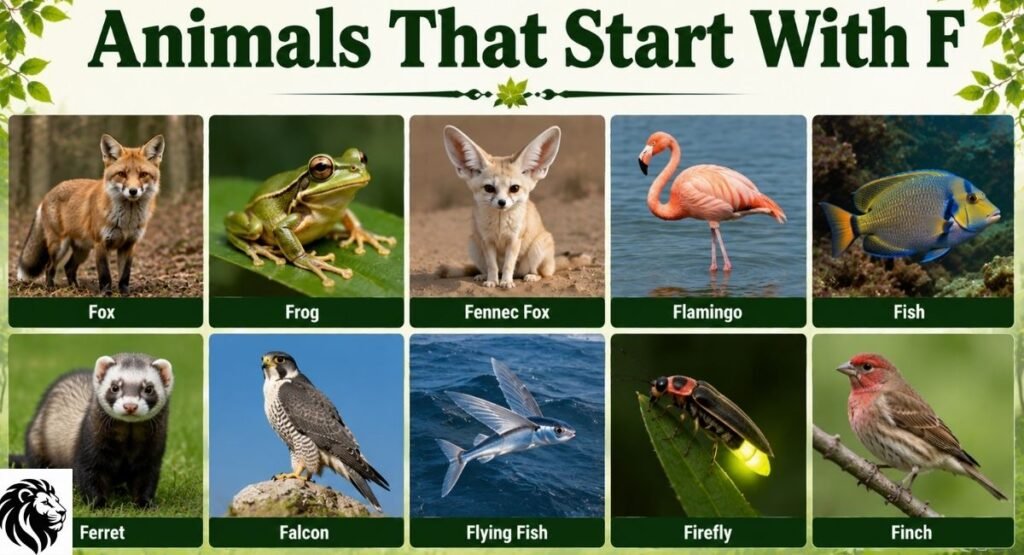
Falcon
Falcons are birds of prey known for powerful flight and excellent hunting skills. Some species can dive at remarkable speeds. Their hooked beaks and sharp talons help them capture prey.
Ferret
Ferrets are small members of the weasel family. Domestic ferrets have been kept by humans for centuries. They have long flexible bodies and strong hunting instincts.
Finch
Finches are small birds with strong, often cone-shaped bills suited for eating seeds. Many species also consume insects and fruits. They can be found in forests, grasslands, gardens, and other habitats.
Flamingo
Flamingos are large wading birds famous for their long legs, curved bills, and pink coloration. Their color comes partly from pigments in their food. They often feed in shallow water.
Fly
Flies are insects found in nearly every environment. Different species consume nectar, decaying material, other insects, or food associated with humans. Their rapid life cycles allow populations to grow quickly under suitable conditions.
Fox
Foxes are small to medium-sized members of the dog family. They are adaptable animals that can live in forests, grasslands, deserts, and even urban environments. Their diets are often highly varied.
Frog
Frogs are amphibians found in many habitats. Most begin life as aquatic tadpoles before developing adult bodies. Frogs eat insects and other small animals and play important roles in food webs.
Animals That Start With G
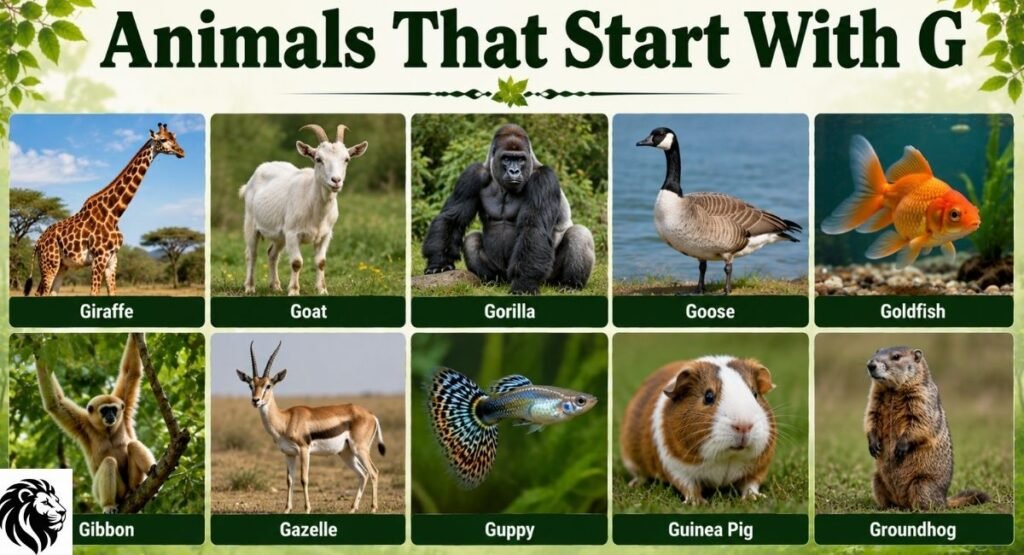
Gazelle
Gazelles are slender antelopes known for speed and agility. Many live in African grasslands and savannas. They mainly eat grasses, leaves, and other vegetation and often depend on speed to escape predators.
Gecko
Geckos are small to medium-sized lizards found in warm regions worldwide. Many species have specialized feet that help them climb smooth surfaces. Their diets commonly include insects and other small animals.
Giraffe
Giraffes are the tallest living land animals. Their long necks allow them to browse leaves high in trees. Their unusual body shape requires specialized cardiovascular adaptations to move blood effectively.
Goat
Goats are domesticated hoofed mammals raised for milk, meat, fiber, and other products. They are adaptable browsers that can eat many kinds of vegetation. Wild goat species also inhabit rugged mountain environments.
Goose
Geese are large waterfowl associated with wetlands, rivers, lakes, and grasslands. Many species migrate seasonally. Their diets commonly include grasses, aquatic plants, grains, and other vegetation.
Gorilla
Gorillas are large great apes native to Africa. They live in family groups and mostly eat vegetation. Despite their size and strength, gorillas often display calm social behavior.
Grasshopper
Grasshoppers are insects with powerful hind legs designed for jumping. Many feed primarily on plants. They form an important part of food webs because birds, reptiles, mammals, and other predators eat them.
Guinea Pig
Guinea pigs are small domesticated rodents originally from South America. They are herbivores that eat grasses, hay, vegetables, and other plant material. They communicate through a variety of sounds.
Animals That Start With H
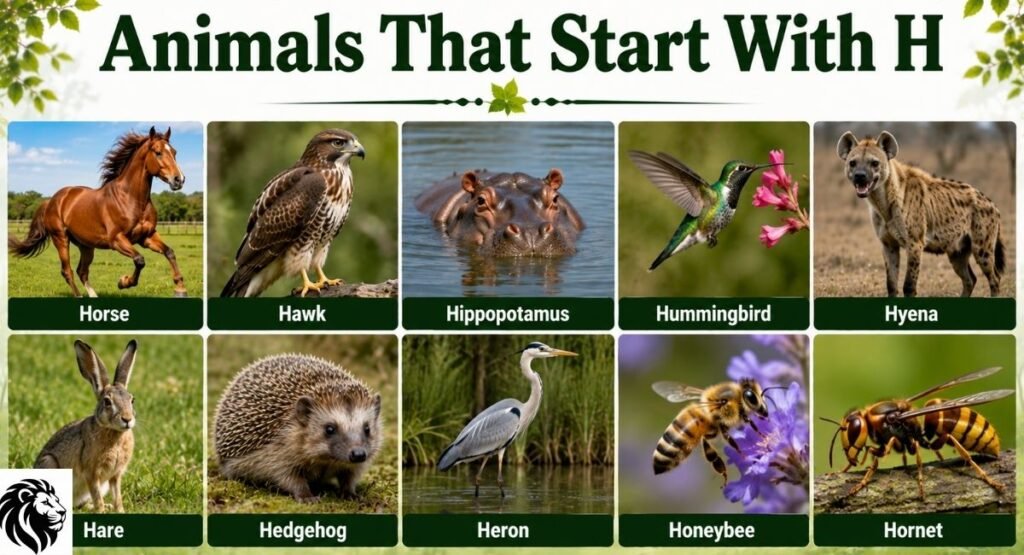
Hamster
Hamsters are small rodents known for their cheek pouches and burrowing behavior. Several species are kept as pets. Wild hamsters live in grasslands, agricultural areas, and other habitats.
Hare
Hares resemble rabbits but differ in several biological and behavioral traits. They usually have longer legs and larger ears. Many species live in open landscapes and rely on speed to escape predators.
Hawk
Hawks are birds of prey with sharp talons and hooked bills. Their strong eyesight helps them locate prey from a distance. Different species inhabit forests, deserts, grasslands, and other landscapes.
Hedgehog
Hedgehogs are small mammals covered with stiff spines. When threatened, many species curl their bodies into a protective ball. They eat insects, worms, small animals, fruits, and other foods.
Hippopotamus
Hippopotamuses are enormous semi-aquatic mammals found in sub-Saharan Africa. They spend much of the day in water and feed mainly on grass. Despite their slow appearance, they can move surprisingly quickly on land.
Hummingbird
Hummingbirds are tiny birds famous for hovering flight. Their wings can beat extremely rapidly, allowing them to remain nearly stationary while feeding. Many species rely heavily on nectar and also consume small insects.
Hyena
Hyenas are carnivorous mammals native mainly to Africa and parts of Asia. They have strong jaws capable of crushing bones. Their social behavior and hunting strategies vary among species.
Horse
Horses are domesticated hoofed mammals closely related to donkeys and zebras. They have long legs built for running. Humans have used horses for transportation, farming, sport, and companionship for thousands of years.
Animals That Start With I
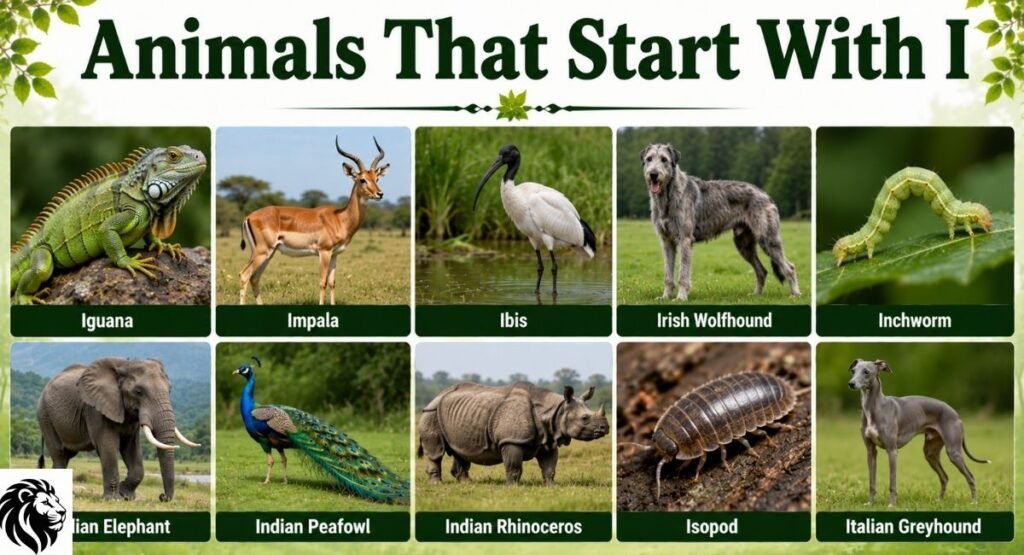
Ibex
Ibexes are wild goats adapted to rocky mountain environments. Their strong legs and specialized hooves help them climb steep terrain. Males of several species have large curved horns.
Ibis
Ibises are long-legged wading birds with distinctive curved bills. They inhabit wetlands, grasslands, and other environments. Their bills help them probe soil and shallow water for food.
Iguana
Iguanas are reptiles found mainly in tropical regions of the Americas and nearby areas. Many species eat plants, although diets vary. Their strong claws and tails help them climb and defend themselves.
Impala
Impalas are graceful African antelopes known for agility and jumping ability. They eat grasses, leaves, and shoots. When threatened, they can make powerful leaps to evade predators.
Insect
Insects form one of the largest animal groups on Earth. Ants, bees, beetles, butterflies, flies, and dragonflies are all insects. Most have six legs and three main body regions.
Animals That Start With J
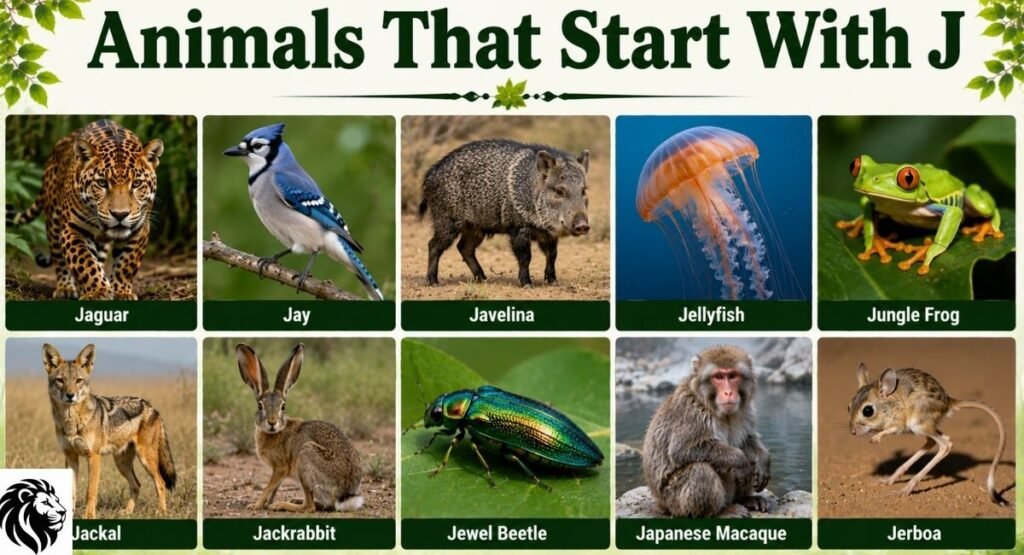
Jackal
Jackals are members of the dog family found mainly in Africa and parts of Eurasia. They are adaptable omnivores that can eat small animals, insects, fruits, and carrion.
Jackrabbit
Jackrabbits are actually hares rather than true rabbits. Their long ears and powerful hind legs help them survive in open landscapes. Several species live in North America.
Jaguar
Jaguars are powerful big cats native mainly to Central and South America. They are excellent swimmers and have exceptionally strong jaws. Their spotted coats help them blend into forest environments.
Jay
Jays are intelligent birds belonging to the crow family. Many species store food and can remember where they placed it. They live in forests, woodlands, and sometimes suburban areas.
Jellyfish
Jellyfish are marine invertebrates with soft, gelatinous bodies. They use specialized cells to capture prey and defend themselves. Despite their simple appearance, they have existed in Earth’s oceans for a very long time.
Jerboa
Jerboas are small jumping rodents found mainly in desert regions of Asia and North Africa. Their long hind legs allow them to move rapidly across sandy terrain. Many are active at night.
Animals That Start With K
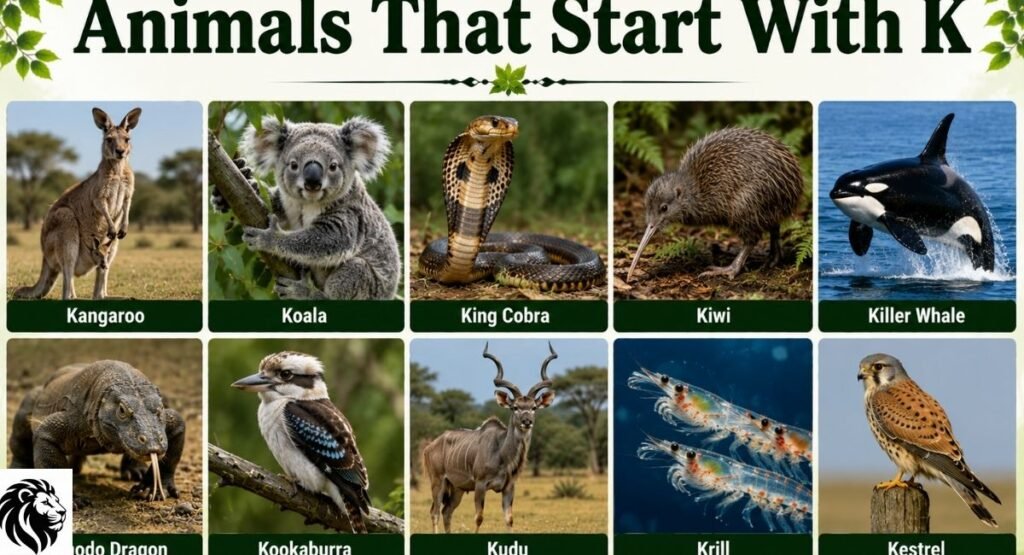
Kangaroo
Kangaroos are iconic Australian marsupials. Their powerful hind legs help them hop across open landscapes. Female kangaroos carry developing young in a pouch and feed mainly on grasses and other vegetation.
Koala
Koalas are Australian marsupials that spend much of their time in eucalyptus trees. Their diet consists mainly of eucalyptus leaves. They conserve energy by resting for many hours each day.
Kiwi
Kiwis are unusual flightless birds native to New Zealand. They have tiny wings, strong legs, and nostrils near the end of their bills. They are primarily nocturnal.
King Cobra
The king cobra is a highly venomous snake found across parts of South and Southeast Asia. It can raise the front of its body when threatened. It mainly feeds on other snakes.
Kookaburra
Kookaburras are Australian kingfishers known for their distinctive calls. Unlike many kingfishers, they often hunt terrestrial prey. Their food can include insects, reptiles, small mammals, and other animals.
Krill
Krill are small marine crustaceans that form a major food source for many ocean animals. Whales, seals, penguins, fish, and seabirds may depend on them directly or indirectly.
Animals That Start With L
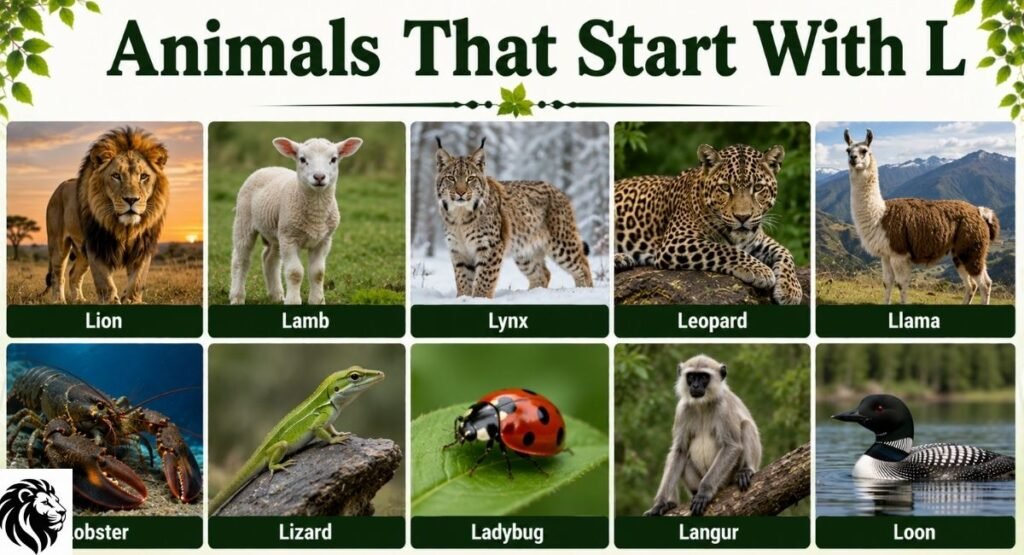
Ladybug
Ladybugs are small beetles often recognized by their rounded bodies and bright markings. Many species eat aphids and other small insects. They can therefore benefit plants by helping control certain pests.
Lemur
Lemurs are primates native to Madagascar. They include many species with different sizes, colors, and lifestyles. Most live in forests and feed on fruits, leaves, insects, or other foods.
Leopard
Leopards are adaptable big cats found across parts of Africa and Asia. They are strong climbers and often drag prey into trees. Their spotted coats provide effective camouflage.
Lion
Lions are large social cats associated mainly with African savannas and grasslands. They live in groups called prides. Lions hunt a variety of hoofed mammals and often cooperate during hunts.
Lizard
Lizards are reptiles found on every continent except Antarctica. They range from tiny geckos to large monitor lizards. Their diets vary from insects and plants to small vertebrates.
Llama
Llamas are domesticated South American camelids. They are commonly used as pack animals and raised for fiber. Their thick coats help them handle cool mountain conditions.
Lobster
Lobsters are large marine crustaceans with hard shells and powerful claws. They live on or near the ocean floor. Their diets include fish, mollusks, worms, and other available food.
Lynx
Lynx are medium-sized wild cats recognized by tufted ears, short tails, and large paws. Several species live across North America, Europe, and Asia. They hunt rabbits, birds, and other prey.
Animals That Start With M
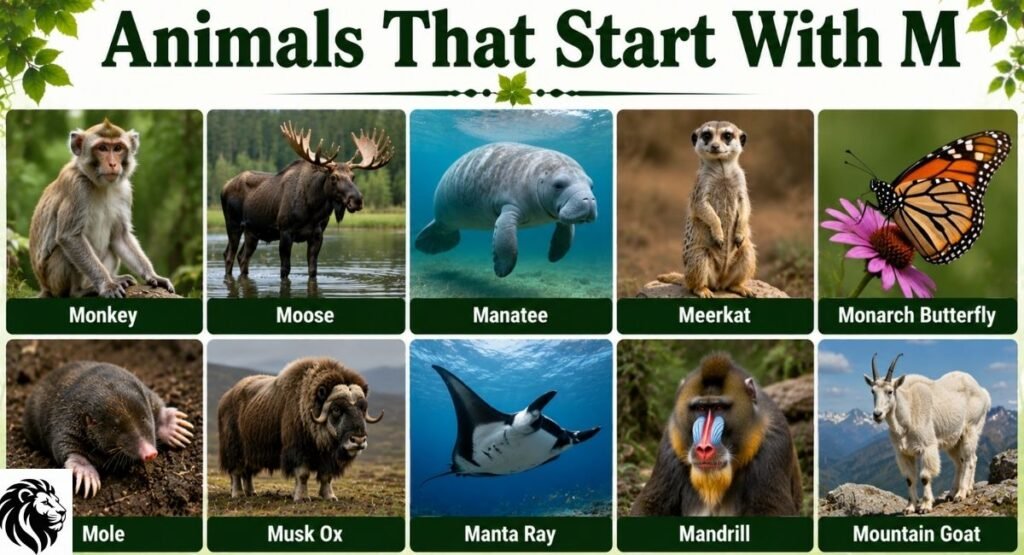
Macaw
Macaws are large, colorful parrots native mainly to Central and South America. Their powerful beaks can crack hard seeds and nuts. Many species form strong social bonds.
Manatee
Manatees are large aquatic mammals sometimes called sea cows. They live in warm coastal waters and freshwater systems. Their diet consists mainly of aquatic plants.
Meerkat
Meerkats are small social mammals native to southern Africa. They live in groups and often use burrows for shelter. One individual may stand upright while others forage nearby.
Mongoose
Mongooses are small to medium-sized mammals found mainly in Africa and parts of Asia. Many eat insects, rodents, reptiles, and other small animals. Some species are famous for their ability to confront snakes.
Monkey
Monkeys are primates found naturally in many parts of the world. They vary greatly in size and behavior. Many species live in social groups and eat fruits, leaves, insects, seeds, or small animals.
Moose
Moose are the largest members of the deer family. They inhabit northern forests and wetlands. Their long legs help them move through deep snow and wet terrain.
Mouse
Mice are small rodents found in many habitats. Some species live close to humans, while others remain in forests, grasslands, or agricultural areas. They usually eat seeds, grains, plants, and other foods.
Mule
Mules are hybrids produced by crossing a female horse with a male donkey. They combine traits from both parents and have historically been valued for their strength and endurance.
Moth
Moths are insects closely related to butterflies. Most species are nocturnal, although some are active during the day. Caterpillars usually feed on plants before transforming into adults.
Animals That Start With N
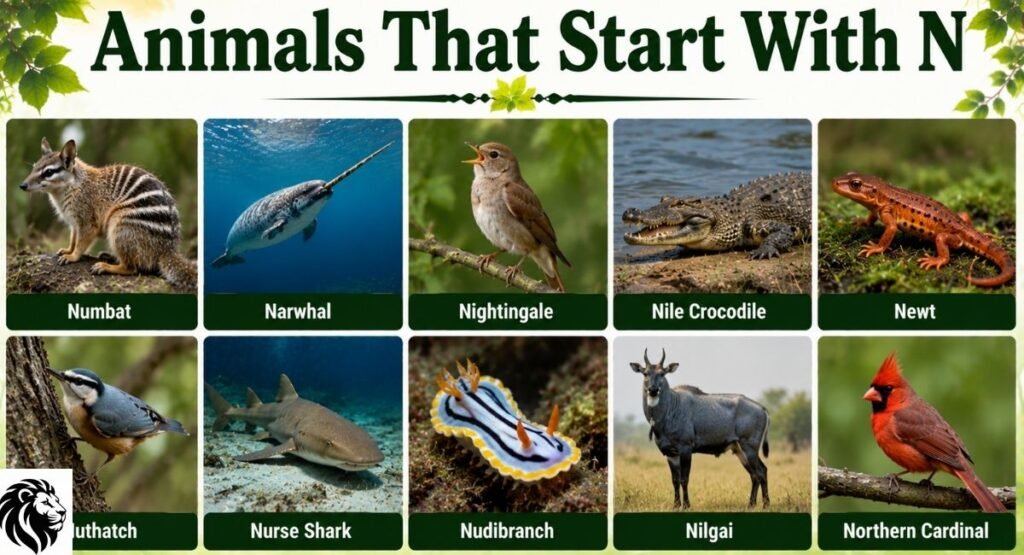
Narwhal
Narwhals are Arctic marine mammals famous for their long tusks. The tusk is actually an elongated tooth. Narwhals live in cold Arctic waters and feed on fish, squid, and other marine prey.
Nautilus
Nautiluses are marine mollusks with spiral shells. They use tentacles to capture food and can control their position in the water. Their lineage has existed for hundreds of millions of years.
Newt
Newts are small amphibians related to salamanders. Many spend part of their lives in water and part on land. They feed on insects, worms, aquatic organisms, and other small prey.
Nightingale
Nightingales are small songbirds famous for their powerful and varied songs. They are associated with Europe, Asia, and parts of Africa depending on the species and migration pattern.
Numbat
The numbat is a small Australian mammal that specializes in eating termites. Unlike many related mammals, it is active during the day. Its striped body helps make it recognizable.
Nuthatch
Nuthatches are small birds that can climb down tree trunks headfirst. They use their strong bills to extract insects and seeds from bark and crevices.
Animals That Start With O
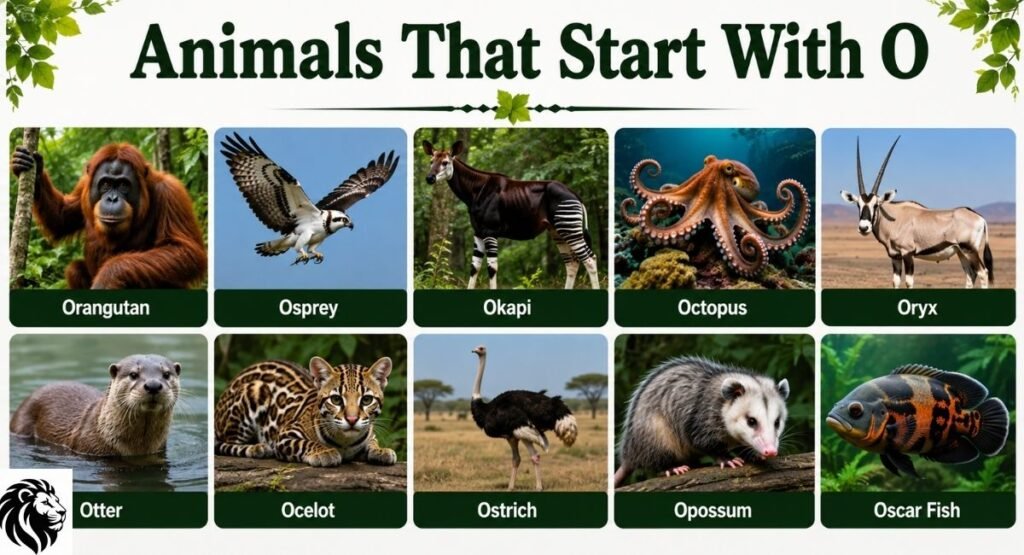
Octopus
Octopuses are intelligent marine mollusks with eight arms. They can change color and texture to communicate, camouflage themselves, or surprise prey. Their flexible bodies allow them to squeeze through surprisingly small openings.
Opossum
Opossums are marsupials native to the Americas. The Virginia opossum is the only marsupial naturally found north of Mexico. Opossums are adaptable omnivores that can live near human communities.
Orangutan
Orangutans are great apes native to Southeast Asia. They spend much of their time in trees and feed heavily on fruit. Their intelligence includes sophisticated tool use and problem-solving.
Orca
Orcas, also called killer whales, are marine mammals belonging to the dolphin family. They live in oceans worldwide and hunt a wide range of prey. Different populations can develop specialized hunting traditions.
Ostrich
Ostriches are the largest living birds. They cannot fly but have powerful legs that allow them to run quickly. They inhabit open landscapes in Africa and mainly eat plant material.
Otter
Otters are semi-aquatic mammals known for swimming ability and playful behavior. Different species live in rivers, lakes, wetlands, and oceans. They feed on fish, crustaceans, amphibians, and other aquatic prey.
Owl
Owls are birds of prey adapted for hunting in low-light conditions. Their large eyes and specialized feathers support hunting and silent flight. Many species are active at night.
Animals That Start With P
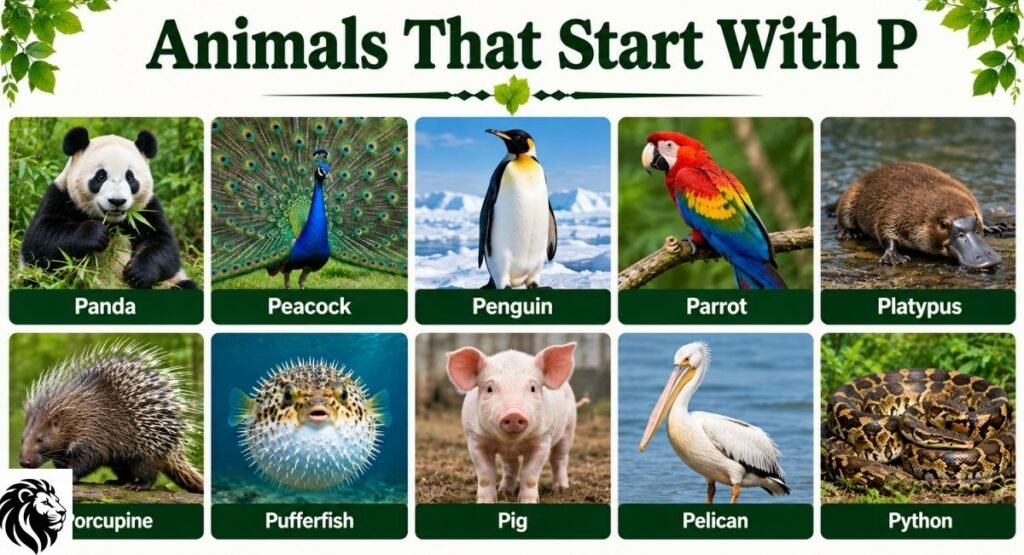
Panda
Giant pandas are bears native to China. Their diet consists mainly of bamboo, although their digestive system retains traits associated with carnivorous ancestors. Pandas spend many hours feeding because bamboo provides relatively little energy.
Panther
“Panther” can refer to different big cats depending on context. It is often used for black leopards or black jaguars. The dark coat results from a genetic condition called melanism.
Parrot
Parrots are colorful birds known for curved bills, strong feet, and advanced vocal abilities. Many species can imitate sounds. Their diets often include fruits, seeds, nuts, flowers, and other plant material.
Peacock
The term peacock specifically refers to a male peafowl. Males are famous for their large decorative tail feathers, which they display during courtship. Peafowl eat seeds, plants, insects, and other foods.
Pelican
Pelicans are large waterbirds recognized by their long bills and expandable throat pouches. They often catch fish in shallow or open water. Their webbed feet make them capable swimmers.
Penguin
Penguins are flightless seabirds adapted for swimming. Their wings function as flippers, while dense feathers and body fat help protect them from cold water. Different species live in various southern regions.
Pigeon
Pigeons are widespread birds found naturally in many regions and closely associated with cities. They can navigate effectively and feed on seeds, grains, fruits, and other food.
Pig
Pigs are intelligent mammals raised worldwide for food and other purposes. Wild pigs and their relatives occupy forests, grasslands, and wetlands. They have strong snouts used for rooting through soil.
Polar Bear
Polar bears are large Arctic bears strongly adapted to life around sea ice. Their thick insulation helps them withstand freezing temperatures. They mainly hunt seals and depend heavily on marine ecosystems.
Porcupine
Porcupines are rodents covered with modified hairs called quills. When threatened, they can raise these defensive structures. They usually eat plants, bark, roots, fruits, and other vegetation.
Animals That Start With Q
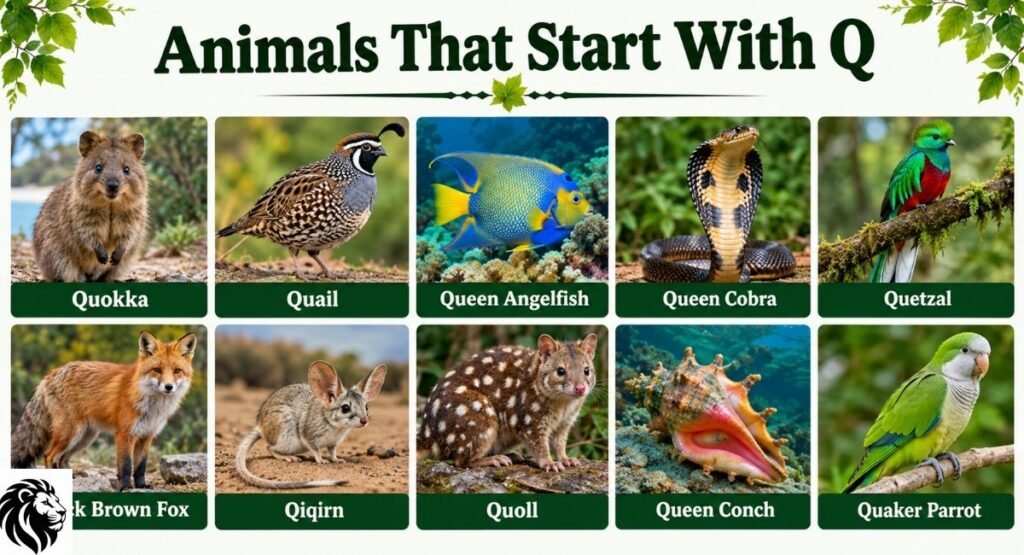
Quail
Quail are small game birds found across several regions. Many species live in grasslands, farmland, scrub, and woodland edges. They eat seeds, grains, plants, and small invertebrates.
Quokka
Quokkas are small marsupials native to parts of Western Australia. They belong to the kangaroo family. Their compact bodies and naturally curious behavior have made them especially recognizable.
Queen Snake
Queen snakes are nonvenomous North American snakes associated with streams and other freshwater habitats. They specialize in eating soft-bodied aquatic prey, particularly certain amphibians.
Quetzal
Quetzals are colorful birds found in parts of the Americas. Several species have brilliant green, blue, or red plumage. They commonly live in forest environments and eat fruits and small animals.
Animals That Start With R
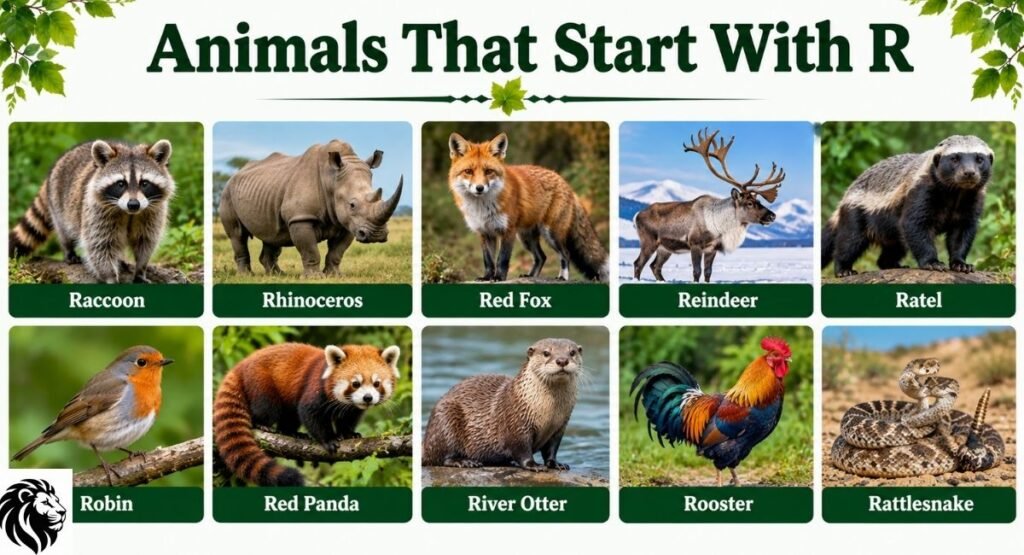
Rabbit
Rabbits are small mammals with powerful hind legs, long ears, and continuously growing teeth. They occur in many habitats and feed mainly on grasses, herbs, and other vegetation.
Raccoon
Raccoons are adaptable North American mammals known for their masked faces and ringed tails. They are omnivorous and can survive in forests, wetlands, suburbs, and cities.
Rat
Rats are rodents found in many habitats worldwide. Some species live closely alongside humans, while others occupy forests and grasslands. Their diets can include grains, fruits, insects, and other foods.
Raven
Ravens are large members of the crow family. They are highly intelligent birds capable of problem-solving and complex social behavior. Their diets are flexible and may include carrion, insects, fruits, and small animals.
Ray
Rays are cartilaginous fish related to sharks. Their flattened bodies and broad fins help them move through water. Some species live on the ocean floor, while others swim in open water.
Reindeer
Reindeer are northern deer adapted to cold environments. They are known for seasonal movements and their ability to feed on lichens. Both males and females of many populations grow antlers.
Rhinoceros
Rhinoceroses are large herbivorous mammals with thick skin and one or two horns depending on the species. Several rhino species face serious conservation threats because of habitat loss and illegal hunting.
Rooster
A rooster is an adult male chicken. Roosters are known for their loud crowing calls and protective behavior around groups of hens. They eat grains, seeds, insects, and other foods.
Animals That Start With R
Shark
Sharks are cartilaginous fish found in oceans worldwide. Their body shapes and diets vary widely. Some eat plankton, while others hunt fish, marine mammals, or other prey.
Sheep
Sheep are domesticated hoofed mammals raised mainly for wool, meat, and milk. They are grazing animals that usually feed on grasses and other vegetation.
Seahorse
Seahorses are small marine fish with upright bodies and curled tails. They are famous because males carry developing embryos in a specialized pouch. They often live among seagrass and other marine vegetation.
Seal
Seals are marine mammals adapted to swimming and cold environments. They use flippers for movement and feed on fish, squid, crustaceans, and other marine prey.
Sloth
Sloths are slow-moving mammals that live mainly in tropical forests of Central and South America. Their long claws help them hang from branches. They mainly eat leaves and other plant material.
Snail
Snails are mollusks found in marine, freshwater, and terrestrial environments. Many have protective shells. Their diets vary, and some species feed on plants while others consume algae or other organisms.
Snake
Snakes are elongated reptiles found on nearly every continent except Antarctica. Some are venomous, while others use constriction to subdue prey. Their diets include insects, fish, birds, mammals, and other animals.
Spider
Spiders are arachnids rather than insects. They have eight legs and produce silk. Some species build webs to catch prey, while others actively hunt insects and small animals.
Squirrel
Squirrels are rodents commonly associated with trees, forests, parks, and gardens. Many species store seeds and nuts for later use. Their strong front teeth help them open hard food.
Swan
Swans are large waterfowl recognized by their long necks and graceful appearance. They live around lakes, rivers, wetlands, and coastal waters. Many species feed mainly on aquatic vegetation.
Animals That Start With T
Tapir
Tapirs are large herbivorous mammals with short, flexible snouts. They live mainly in forests and wetlands of Central and South America and parts of Southeast Asia. Their diets include leaves, fruits, and aquatic plants.
Tarantula
Tarantulas are large spiders covered with fine hairs. Many live in burrows or other sheltered places. They use venom to subdue prey, which commonly includes insects and other small animals.
Tiger
Tigers are large cats native to Asia. They are powerful solitary predators that hunt deer, wild pigs, and other animals. Their striped coats provide camouflage in vegetation.
Tortoise
Tortoises are land-dwelling reptiles with protective shells. Many species are herbivorous and feed on grasses, leaves, flowers, and fruits. Their slow metabolism can support long lifespans.
Toucan
Toucans are tropical birds recognized by their large colorful bills. Their bills are surprisingly lightweight because they contain internal air spaces. Toucans eat fruits, insects, eggs, and small animals.
Trout
Trout are freshwater fish belonging to the salmon family. They often live in cool, clean streams and lakes. Many species feed on aquatic insects, smaller fish, and other organisms.
Turkey
Turkeys are large birds native to North America. Wild turkeys live in forests, grasslands, and woodland edges. They eat seeds, nuts, insects, fruits, and other foods.
Turtle
Turtles are reptiles with protective shells and aquatic or semi-aquatic lifestyles. Different species live in oceans, rivers, lakes, and wetlands. Their diets range from plants to small animals.
Animals That Start With U
Uakari
Uakaris are small primates native to the Amazon Basin. They have short tails and strong limbs suited to life in forest environments. Several species spend much of their time in trees.
Umbrellabird
Umbrellabirds are tropical birds named for their distinctive umbrella-like crests. They live in forest environments of Central and South America. Their diets include fruits and other plant material.
Unicornfish
Unicornfish are marine fish related to surgeonfish. Some species have a horn-like projection on their forehead. They live mainly around tropical reefs and feed on algae and other food.
Urial
Urials are wild sheep found in parts of Central and South Asia. They inhabit grasslands, rocky slopes, and mountain environments. Males have large curved horns.
Animals That Start With V
Vampire Bat
Vampire bats are small bats native to parts of Central and South America. They feed on blood rather than insects or fruit. Their specialized teeth and digestive systems support this unusual diet.
Vicuna
Vicunas are small wild camelids native to the high Andes. They are closely related to alpacas and llamas. Their fine wool and ability to survive at high elevations make them remarkable animals.
Viper
Vipers are venomous snakes found across many regions. They typically have specialized fangs that inject venom into prey. Different species live in deserts, forests, mountains, and grasslands.
Vulture
Vultures are scavenging birds that feed primarily on carrion. They play an important ecological role by consuming dead animals. Their strong digestive systems help them process food that could be dangerous to many other species.
Animals That Start With W
Walrus
Walruses are large Arctic marine mammals recognized by their long tusks and whiskers. They use their tusks for several purposes and feed mainly on clams and other seafloor animals.
Weasel
Weasels are small carnivorous mammals belonging to the mustelid family. Their long, flexible bodies help them enter narrow spaces. They hunt rodents, birds, insects, and other small prey.
Whale
Whales are large marine mammals that breathe air through blowholes. Different species have different diets and feeding methods. Some filter tiny organisms from water, while others actively hunt fish or marine mammals.
Wildebeest
Wildebeest are large African antelopes known for seasonal migrations. They graze mainly on grasses and often travel in large herds. Their movements follow changing rainfall and food availability.
Wolf
Wolves are social members of the dog family. They live in packs and cooperate during hunting and raising young. Their diets commonly include deer, elk, smaller mammals, and other prey.
Wombat
Wombats are sturdy Australian marsupials that spend much of their time in burrows. They are herbivores with powerful claws for digging. Their compact bodies help them navigate underground tunnels.
Woodpecker
Woodpeckers are birds adapted for climbing tree trunks and searching for food under bark. Their strong bills help them excavate wood. Many species eat insects, larvae, seeds, or fruit.
Animals That Start With X
X-ray Tetra
The X-ray tetra is a small freshwater fish native to South America. Its body is partly transparent, allowing some internal structures to be seen. It is also popular in freshwater aquariums.
Xerus
Xerus refers to African ground squirrels. These rodents live mainly in dry and open environments. They spend time searching for seeds, roots, vegetation, and other foods.
Xantus’s Hummingbird
Xantus’s hummingbird is a small hummingbird associated with Baja California and nearby areas. Like other hummingbirds, it feeds heavily on nectar while also consuming tiny insects.
Animals That Start With Y
Yak
Yaks are large bovine mammals adapted to cold, high-altitude environments. Domestic yaks provide milk, meat, fiber, and transport in some mountain communities. Their thick coats protect them from severe weather.
Yabby
Yabbies are freshwater crayfish native to Australia. They inhabit rivers, dams, wetlands, and other freshwater environments. They are omnivorous and consume plants, detritus, and small aquatic organisms.
Yellowhammer
The yellowhammer is a songbird native to parts of Europe and Asia. Males have striking yellow plumage. They often inhabit farmland, hedgerows, grasslands, and open woodland.
Yellowjacket
Yellowjackets are wasps known for their yellow and black markings. Some species build large social colonies. They can hunt insects and also feed on sugary foods and other materials.
Animals That Start With Z
Zebra
Zebras are African hoofed mammals recognized by their distinctive black-and-white stripes. They are grazing animals that live mainly in grasslands and savannas. Their social groups provide protection against predators.
Zebra Shark
The zebra shark is a marine fish found in warm coastal waters of the Indo-Pacific. Young zebra sharks have striking patterns that change as they mature. Adults often rest on sandy or rocky seafloors.
Zebu
Zebus are domesticated cattle recognized by a prominent hump over their shoulders. They are particularly well adapted to hot climates. People raise them for meat, milk, work, and other agricultural purposes.
Zander
Zander are freshwater fish related to perch. They are native to parts of Europe and western Asia and have been introduced elsewhere. They are predators that feed on smaller fish and aquatic organisms.
Zorilla
The zorilla, also called the striped polecat, is a small African carnivore. Its bold black-and-white pattern resembles that of a skunk. When threatened, it can release a powerful-smelling defensive secretion.
200+ Animal Names A to Z: Quick Reference
Here is an expanded 220 animal names A to Z reference table. It includes mammals, birds, reptiles, amphibians, fish, insects, and other animals. The table also shows each animal’s type, habitat, and typical diet, making it useful for quick searches and learning.
| Animal | Letter | Type | Habitat | Diet |
| Aardvark | A | Mammal | Savanna | Insects |
| Albatross | A | Bird | Ocean | Fish and squid |
| Alligator | A | Reptile | Wetlands | Carnivore |
| Alpaca | A | Mammal | Mountains | Herbivore |
| Ant | A | Insect | Many habitats | Omnivore |
| Antelope | A | Mammal | Grasslands | Herbivore |
| Anaconda | A | Reptile | Wetlands | Carnivore |
| Armadillo | A | Mammal | Forests and grasslands | Insectivore |
| Axolotl | A | Amphibian | Freshwater | Carnivore |
| Ape | A | Mammal | Forests | Omnivore |
| Auk | A | Bird | Coastal areas | Fish |
| Avocet | A | Bird | Wetlands | Invertebrates |
| Baboon | B | Mammal | Savanna and forests | Omnivore |
| Badger | B | Mammal | Forests and grasslands | Omnivore |
| Bat | B | Mammal | Forests and caves | Insects or fruit |
| Bear | B | Mammal | Forests and tundra | Omnivore |
| Beaver | B | Mammal | Rivers and wetlands | Herbivore |
| Bison | B | Mammal | Grasslands | Herbivore |
| Buffalo | B | Mammal | Grasslands and wetlands | Herbivore |
| Butterfly | B | Insect | Gardens and forests | Nectar |
| Blue Whale | B | Marine mammal | Oceans | Krill |
| Boa | B | Reptile | Forests and grasslands | Carnivore |
| Bobcat | B | Mammal | Forests and deserts | Carnivore |
| Beetle | B | Insect | Many habitats | Varied |
| Camel | C | Mammal | Deserts | Herbivore |
| Capybara | C | Mammal | Wetlands | Herbivore |
| Caribou | C | Mammal | Tundra and forests | Herbivore |
| Cat | C | Mammal | Homes and many habitats | Carnivore |
| Cheetah | C | Mammal | Grasslands | Carnivore |
| Chicken | C | Bird | Farms and woodlands | Omnivore |
| Chimpanzee | C | Mammal | Rainforests | Omnivore |
| Cobra | C | Reptile | Forests and grasslands | Carnivore |
| Crocodile | C | Reptile | Rivers and wetlands | Carnivore |
| Crab | C | Crustacean | Oceans and shorelines | Omnivore |
| Canary | C | Bird | Woodlands and homes | Seeds |
| Condor | C | Bird | Mountains and open areas | Carrion |
| Deer | D | Mammal | Forests and grasslands | Herbivore |
| Dingo | D | Mammal | Grasslands and forests | Carnivore |
| Dog | D | Mammal | Domestic environments | Omnivore |
| Dolphin | D | Marine mammal | Oceans | Fish and squid |
| Donkey | D | Mammal | Grasslands and farms | Herbivore |
| Dragonfly | D | Insect | Wetlands | Carnivore |
| Dugong | D | Marine mammal | Coastal waters | Herbivore |
| Duck | D | Bird | Wetlands and ponds | Omnivore |
| Dove | D | Bird | Woodlands and cities | Seeds |
| Dormouse | D | Mammal | Forests | Omnivore |
| Eagle | E | Bird | Mountains and forests | Carnivore |
| Eel | E | Fish | Freshwater and oceans | Carnivore |
| Elephant | E | Mammal | Savanna and forests | Herbivore |
| Elk | E | Mammal | Forests and mountains | Herbivore |
| Emu | E | Bird | Grasslands and woodlands | Omnivore |
| Echidna | E | Mammal | Forests and grasslands | Insectivore |
| Earthworm | E | Invertebrate | Soil | Organic matter |
| Egret | E | Bird | Wetlands | Fish and insects |
| Falcon | F | Bird | Mountains and open areas | Carnivore |
| Ferret | F | Mammal | Grasslands and homes | Carnivore |
| Finch | F | Bird | Forests and gardens | Seeds and insects |
| Flamingo | F | Bird | Wetlands | Algae and small organisms |
| Fly | F | Insect | Many habitats | Varied |
| Fox | F | Mammal | Forests and grasslands | Omnivore |
| Frog | F | Amphibian | Wetlands and forests | Insectivore |
| Fowl | F | Bird | Farms and woodlands | Omnivore |
| Gazelle | G | Mammal | Grasslands | Herbivore |
| Gecko | G | Reptile | Forests and deserts | Insectivore |
| Giraffe | G | Mammal | Savanna | Herbivore |
| Goat | G | Mammal | Mountains and farms | Herbivore |
| Goose | G | Bird | Wetlands and grasslands | Herbivore and omnivore |
| Gorilla | G | Mammal | Rainforests | Herbivore |
| Grasshopper | G | Insect | Grasslands | Herbivore |
| Guinea Pig | G | Mammal | Grasslands and homes | Herbivore |
| Grouse | G | Bird | Forests and grasslands | Omnivore |
| Hamster | H | Mammal | Grasslands and homes | Omnivore |
| Hare | H | Mammal | Grasslands | Herbivore |
| Hawk | H | Bird | Forests and open land | Carnivore |
| Hedgehog | H | Mammal | Grasslands and gardens | Insectivore |
| Hippopotamus | H | Mammal | Rivers and wetlands | Herbivore |
| Hummingbird | H | Bird | Gardens and forests | Nectar and insects |
| Hyena | H | Mammal | Savanna | Carnivore and scavenger |
| Horse | H | Mammal | Grasslands and farms | Herbivore |
| Heron | H | Bird | Wetlands | Fish |
| Hermit Crab | H | Crustacean | Coastal areas | Omnivore |
| Ibex | I | Mammal | Mountains | Herbivore |
| Ibis | I | Bird | Wetlands | Omnivore |
| Iguana | I | Reptile | Tropical forests | Herbivore |
| Impala | I | Mammal | Savanna | Herbivore |
| Insect | I | Invertebrate | Almost everywhere | Varied |
| Isopod | I | Crustacean | Land and water | Detritivore |
| Jackal | J | Mammal | Savanna and deserts | Omnivore |
| Jackrabbit | J | Mammal | Deserts and grasslands | Herbivore |
| Jaguar | J | Mammal | Rainforests and wetlands | Carnivore |
| Jay | J | Bird | Forests and gardens | Omnivore |
| Jellyfish | J | Marine invertebrate | Oceans | Small marine animals |
| Jerboa | J | Mammal | Deserts | Herbivore and omnivore |
| Junco | J | Bird | Forests and gardens | Seeds and insects |
| Kangaroo | K | Mammal | Grasslands and woodlands | Herbivore |
| Koala | K | Mammal | Eucalyptus forests | Herbivore |
| Kiwi | K | Bird | Forests | Omnivore |
| King Cobra | K | Reptile | Forests and grasslands | Carnivore |
| Kookaburra | K | Bird | Woodlands | Carnivore |
| Krill | K | Crustacean | Oceans | Plankton |
| Kudu | K | Mammal | Savanna | Herbivore |
| Ladybug | L | Insect | Gardens and forests | Insectivore |
| Lemur | L | Mammal | Forests | Omnivore |
| Leopard | L | Mammal | Forests and grasslands | Carnivore |
| Lion | L | Mammal | Savanna | Carnivore |
| Lizard | L | Reptile | Deserts and forests | Varied |
| Llama | L | Mammal | Mountains and farms | Herbivore |
| Lobster | L | Crustacean | Oceans | Omnivore |
| Lynx | L | Mammal | Forests and mountains | Carnivore |
| Lorikeet | L | Bird | Tropical forests | Nectar and fruit |
| Macaw | M | Bird | Rainforests | Herbivore and omnivore |
| Manatee | M | Marine mammal | Coastal waters | Herbivore |
| Meerkat | M | Mammal | Deserts and savanna | Omnivore |
| Mongoose | M | Mammal | Grasslands and forests | Carnivore and omnivore |
| Monkey | M | Mammal | Forests | Omnivore |
| Moose | M | Mammal | Forests and wetlands | Herbivore |
| Mouse | M | Mammal | Many habitats | Omnivore |
| Mule | M | Mammal | Farms and grasslands | Herbivore |
| Moth | M | Insect | Forests and gardens | Nectar or plant matter |
| Magpie | M | Bird | Woodlands and cities | Omnivore |
| Narwhal | N | Marine mammal | Arctic waters | Fish and squid |
| Nautilus | N | Mollusk | Oceans | Carnivore |
| Newt | N | Amphibian | Ponds and forests | Insectivore |
| Nightingale | N | Bird | Forests and shrublands | Insects and berries |
| Numbat | N | Mammal | Woodlands | Insectivore |
| Nuthatch | N | Bird | Forests | Insects and seeds |
| Nightjar | N | Bird | Forests and grasslands | Insects |
| Octopus | O | Marine invertebrate | Oceans | Carnivore |
| Opossum | O | Mammal | Forests and urban areas | Omnivore |
| Orangutan | O | Mammal | Rainforests | Omnivore |
| Orca | O | Marine mammal | Oceans | Carnivore |
| Ostrich | O | Bird | Savanna | Omnivore |
| Otter | O | Mammal | Rivers and coasts | Carnivore |
| Owl | O | Bird | Forests and grasslands | Carnivore |
| Ocelot | O | Mammal | Tropical forests | Carnivore |
| Panda | P | Mammal | Bamboo forests | Herbivore |
| Panther | P | Mammal | Forests and grasslands | Carnivore |
| Parrot | P | Bird | Tropical forests | Omnivore |
| Peacock | P | Bird | Forests and farms | Omnivore |
| Pelican | P | Bird | Coasts and wetlands | Carnivore |
| Penguin | P | Bird | Coastal and polar regions | Carnivore |
| Pigeon | P | Bird | Cities and cliffs | Omnivore |
| Pig | P | Mammal | Farms and forests | Omnivore |
| Polar Bear | P | Mammal | Arctic | Carnivore |
| Porcupine | P | Mammal | Forests and grasslands | Herbivore |
| Piranha | P | Fish | Freshwater | Carnivore |
| Quail | Q | Bird | Grasslands and forests | Omnivore |
| Quokka | Q | Mammal | Woodlands | Herbivore |
| Queen Snake | Q | Reptile | Wetlands | Carnivore |
| Quetzal | Q | Bird | Cloud forests | Omnivore |
| Rabbit | R | Mammal | Grasslands and forests | Herbivore |
| Raccoon | R | Mammal | Forests and urban areas | Omnivore |
| Rat | R | Mammal | Cities and many habitats | Omnivore |
| Raven | R | Bird | Forests and mountains | Omnivore |
| Ray | R | Fish | Oceans | Varied |
| Reindeer | R | Mammal | Arctic and forests | Herbivore |
| Rhinoceros | R | Mammal | Grasslands and savanna | Herbivore |
| Rooster | R | Bird | Farms and woodlands | Omnivore |
| Robin | R | Bird | Gardens and woodlands | Insects and fruit |
| Shark | S | Fish | Oceans | Carnivore |
| Sheep | S | Mammal | Grasslands and farms | Herbivore |
| Seahorse | S | Fish | Coastal waters | Small crustaceans |
| Seal | S | Marine mammal | Oceans and coasts | Carnivore |
| Sloth | S | Mammal | Rainforests | Herbivore |
| Snail | S | Mollusk | Gardens and freshwater | Herbivore or omnivore |
| Snake | S | Reptile | Forests, deserts, and wetlands | Carnivore |
| Spider | S | Arachnid | Almost everywhere | Carnivore |
| Squirrel | S | Mammal | Forests and urban areas | Omnivore |
| Swan | S | Bird | Lakes and wetlands | Herbivore |
| Salamander | S | Amphibian | Forests and wetlands | Insectivore |
| Tapir | T | Mammal | Rainforests and wetlands | Herbivore |
| Tarantula | T | Arachnid | Deserts and forests | Carnivore |
| Tiger | T | Mammal | Forests and grasslands | Carnivore |
| Tortoise | T | Reptile | Deserts and grasslands | Herbivore |
| Toucan | T | Bird | Rainforests | Omnivore |
| Trout | T | Fish | Freshwater | Carnivore |
| Turkey | T | Bird | Forests and grasslands | Omnivore |
| Turtle | T | Reptile | Oceans, rivers, and wetlands | Varied |
| Tamarin | T | Mammal | Tropical forests | Omnivore |
| Uakari | U | Mammal | Amazon rainforest | Omnivore |
| Umbrellabird | U | Bird | Tropical forests | Omnivore |
| Unicornfish | U | Fish | Coral reefs | Herbivore |
| Urial | U | Mammal | Mountains and grasslands | Herbivore |
| Vampire Bat | V | Mammal | Tropical forests | Blood |
| Vicuna | V | Mammal | Andes mountains | Herbivore |
| Viper | V | Reptile | Forests and deserts | Carnivore |
| Vulture | V | Bird | Grasslands and savanna | Scavenger |
| Vaquita | V | Marine mammal | Coastal waters | Fish and squid |
| Walrus | W | Marine mammal | Arctic waters | Carnivore |
| Weasel | W | Mammal | Forests and grasslands | Carnivore |
| Whale | W | Marine mammal | Oceans | Varied |
| Wildebeest | W | Mammal | African grasslands | Herbivore |
| Wolf | W | Mammal | Forests and tundra | Carnivore |
| Wombat | W | Mammal | Woodlands | Herbivore |
| Woodpecker | W | Bird | Forests and woodlands | Insectivore |
| Warthog | W | Mammal | Savanna | Herbivore |
| X-ray Tetra | X | Fish | Freshwater | Omnivore |
| Xerus | X | Mammal | African savanna | Herbivore |
| Xantus’s Hummingbird | X | Bird | Dry forests and scrub | Nectar and insects |
| Xiphias | X | Fish | Oceans | Carnivore |
| Yak | Y | Mammal | Mountains and grasslands | Herbivore |
| Yabby | Y | Crustacean | Freshwater | Omnivore |
| Yellowhammer | Y | Bird | Grasslands and farmland | Seeds and insects |
| Yellowjacket | Y | Insect | Forests and gardens | Omnivore |
| Yellowfin Tuna | Y | Fish | Tropical oceans | Carnivore |
| Zebra | Z | Mammal | African grasslands | Herbivore |
| Zebra Shark | Z | Fish | Tropical oceans | Carnivore |
| Zebu | Z | Mammal | Grasslands and farms | Herbivore |
| Zander | Z | Fish | Freshwater | Carnivore |
| Zorilla | Z | Mammal | Grasslands and savanna | Carnivore |
| Zebra Dove | Z | Bird | Woodlands and cities | Seeds |
Animal Names by Type
Animal classification provides another useful way to explore the A to Z animal list. Instead of looking only at spelling, you can group animals according to major biological characteristics.
Mammals A to Z
Mammals include lions, elephants, bears, monkeys, rodents, marsupials, and marine mammals. Most have hair and produce milk for their young.
The group includes animals with extremely different lifestyles. A bat flies through the night, a whale swims through oceans, and a moose walks through northern forests.
Birds A to Z
Birds include eagles, owls, parrots, penguins, flamingos, and ostriches. Feathers are one of their defining features.
Some birds fly long distances, while others have evolved for running or swimming. Their diets range from nectar and seeds to fish and small mammals.
Reptiles A to Z
Reptiles include snakes, lizards, crocodiles, turtles, and tortoises. Many have scales and depend on external heat sources to regulate body temperature.
Their habitats can include deserts, forests, rivers, wetlands, and oceans. Their adaptations help them survive in very different conditions.
Amphibians A to Z
Amphibians include frogs, toads, newts, and salamanders. Many have life cycles connected to water.
Their sensitive skin makes them vulnerable to changes in environmental conditions. For this reason, amphibians can sometimes act as useful indicators of ecosystem health.
Fish A to Z
Fish include sharks, rays, eels, trout, tetra, and piranha. They are aquatic vertebrates that generally use gills to obtain oxygen.
Fish have evolved into countless body shapes. Some live near the surface, while others survive in deep water, fast streams, coral reefs, or freshwater lakes.
Insects and Arachnids A to Z
Ants, bees, butterflies, dragonflies, spiders, and tarantulas are common examples. Insects and arachnids are both arthropods, but they have important differences.
Most insects have six legs, while arachnids generally have eight. This simple distinction can help you identify unfamiliar small creatures.
Ocean Animals A to Z
Ocean ecosystems support an astonishing variety of life. Some species spend their entire lives underwater, while others must return to the surface to breathe.
The ocean animals A to Z category includes dolphins, whales, sharks, octopuses, seahorses, sea turtles, seals, sea otters, walruses, and stingrays.
Popular Ocean Animals
Dolphins are social marine mammals known for sophisticated communication. Whales range from enormous filter feeders to active predators. Sharks and rays belong to a different group of fish with skeletons made primarily of cartilage.
Octopuses are intelligent mollusks. Seahorses are fish with unusual body shapes. Sea turtles are reptiles that breathe air, while seals and walruses are marine mammals.
Marine Animal Groups
Marine mammals include whales, dolphins, seals, sea lions, manatees, dugongs, and walruses. They breathe air even though they spend much of their lives in water.
Other marine groups include fish, marine reptiles, mollusks, and crustaceans. These groups differ in anatomy, reproduction, feeding, and evolutionary history.
Animals by Habitat
Habitats determine what animals can eat, where they can shelter, and how they reproduce. A species adapted to freezing Arctic conditions may struggle to survive in a hot desert.
Understanding animal habitats therefore helps explain why different creatures have developed such unusual bodies and behaviors.
Forest Animals
Forests provide food, shelter, nesting locations, and climbing opportunities. Bears, deer, wolves, squirrels, owls, woodpeckers, and many insects can inhabit forest ecosystems.
Different forest layers create different living spaces. Birds may occupy the canopy, while mammals forage closer to the ground.
Rainforest Animals
Rainforests contain exceptional biodiversity. Jaguars, orangutans, sloths, toucans, frogs, snakes, and countless insects occupy different ecological niches.
The forest canopy can act almost like a separate ecosystem. Animals living high above the ground may encounter very different food and shelter from species living below.
Desert Animals
Desert animals face heat, dryness, and limited water. Many become active at night when temperatures drop.
Snakes, lizards, foxes, rodents, insects, and camels demonstrate different desert adaptations. Some hide underground, while others conserve water through specialized physiology.
Grassland Animals
Grasslands support grazers such as zebras, bison, antelope, and wildebeest. Predators follow these herbivores because large groups provide reliable food sources.
Open habitats also favor animals that can run quickly or detect predators from a distance.
Arctic Animals
Arctic animals face freezing temperatures and seasonal changes in sunlight. Polar bears, Arctic foxes, seals, and walruses have specialized adaptations for survival.
Insulation is especially important. Fur, feathers, and body fat can help reduce heat loss in extremely cold environments.
Antarctic Animals
Antarctic wildlife depends heavily on the surrounding ocean. Penguins and seals are among the most recognizable animals, while krill form an important part of the marine food web.
The extreme climate limits terrestrial biodiversity. Much of the region’s animal productivity comes from marine ecosystems.
Ocean Animals
The ocean contains shallow reefs, coastal wetlands, deep water, kelp forests, and open seas. Each environment supports different species.
Depth affects light, pressure, temperature, and food availability. As a result, animals living in deep water can look very different from animals near the surface.
Freshwater Animals
Freshwater ecosystems include lakes, rivers, streams, ponds, and wetlands. Fish, frogs, turtles, beavers, otters, insects, and water birds can all depend on these habitats.
Freshwater environments are especially important because they connect land and water ecosystems. Changes in water quality can affect many species simultaneously.
Mountain Animals
Mountain animals must cope with steep slopes, cold temperatures, and changing weather. Yaks, ibexes, mountain goats, and snow leopards demonstrate different adaptations.
Strong legs and specialized hooves can help animals climb rocky terrain. Thick coats can protect them from cold temperatures.
Savanna Animals
Savannas contain grasses, scattered trees, seasonal rainfall, and large herds of herbivores. Lions, elephants, giraffes, zebras, and wildebeest are iconic examples.
Seasonal rainfall controls plant growth. Herbivores follow food availability, while predators follow their prey.
Animal Classification Explained
Classification helps scientists organize the enormous diversity of life. It also makes it easier for students to understand how different animals are related.
A basic animal classification system begins with broad groups and becomes more specific. Scientific names provide greater precision than everyday animal names.
What Is Animal Classification?
Animal classification is the process of grouping organisms according to shared characteristics and evolutionary relationships.
It helps scientists compare anatomy, genetics, behavior, reproduction, and other traits. For readers, broad groups such as mammals and birds provide a useful starting point.
Animal Kingdom
Animals belong to Kingdom Animalia. The kingdom contains vertebrates and invertebrates.
This means a dog, butterfly, whale, octopus, and eagle all belong to the same broad kingdom despite their huge differences.
Vertebrates vs. Invertebrates
Vertebrates have a backbone. Mammals, birds, reptiles, amphibians, and fish are commonly grouped as vertebrates.
Invertebrates lack a backbone. Insects, spiders, worms, crabs, jellyfish, and octopuses belong to this broad category.
Mammals
Mammals generally have hair or fur and feed their young with milk. Most give birth to live young, although egg-laying mammals exist.
Mammals occupy almost every major environment. They include bats, whales, elephants, rodents, primates, and many other forms.
Birds
Birds have feathers and beaks and reproduce by laying eggs. Many species fly, but some have adapted to swimming or running.
Penguins use their wings as flippers, while ostriches use powerful legs to run across open landscapes.
Reptiles
Reptiles include snakes, lizards, turtles, tortoises, and crocodilians. Their bodies often have scales that help reduce water loss.
They live in deserts, forests, wetlands, oceans, and grasslands.
Amphibians
Amphibians include frogs, toads, newts, and salamanders. Many have life stages that involve both water and land.
Their permeable skin makes them especially sensitive to environmental changes.
Fish
Fish are aquatic vertebrates that generally use gills to obtain oxygen. Sharks, rays, eels, trout, and tetras demonstrate the group’s enormous diversity.
Some fish live in freshwater, while others occupy marine environments.
Insects
Insects are arthropods with six legs and three main body regions. Many species also have wings.
Bees, ants, butterflies, beetles, flies, and dragonflies are all insects.
Classes, Orders, Families, Genus and Species
Scientific classification becomes more specific as you move downward. Class, order, and family organize related organisms into increasingly focused groups.
The genus contains closely related species, while a species represents a more specific biological group. Scientific naming helps researchers avoid confusion caused by different common names.
Fascinating Animal Facts
Animals have evolved some extraordinary abilities. Their bodies reflect millions of years of adaptation to changing environments.
Largest Animals
The blue whale is the largest known animal. On land, the African elephant is among the largest living terrestrial animals.
Large bodies require enormous amounts of energy. Marine environments can support greater body size because water helps support the animal’s weight.
Smallest Animals
Some animals are incredibly tiny. Small mammals, frogs, fish, insects, and other creatures demonstrate how little space a successful body plan may require.
Small size can provide advantages such as lower energy requirements and access to hiding places unavailable to larger animals.
Fastest Animals
Cheetahs are famous for rapid acceleration and high running speeds over short distances. Peregrine falcons can reach remarkable speeds during hunting dives.
Speed is only one survival strategy. Camouflage, endurance, agility, and cooperation can also determine hunting success.
Tallest Animals
The giraffe is the tallest living land animal. Its long neck allows it to reach vegetation that many other herbivores cannot easily access.
Its heart and blood vessels have specialized adaptations because blood must travel efficiently through a very tall body.
Heaviest Animals
The largest animals live in the ocean. Blue whales demonstrate how marine environments can support enormous bodies.
Water provides buoyancy, which reduces some of the structural challenges faced by animals living on land.
Strongest Animals
Strength can be measured in different ways. Elephants have enormous absolute strength, while some insects can move loads many times heavier than their own bodies.
Relative strength therefore gives a very different result from total force.
Smartest Animals
Animal intelligence appears through communication, memory, problem-solving, tool use, and social learning.
Great apes, dolphins, elephants, corvids, and some cephalopods have demonstrated impressive cognitive abilities.
Longest-Living Animals
Some animals live for decades or longer. Certain turtles, whales, fish, and other species are known for unusually long lifespans.
Lifespan depends on many factors, including metabolism, predators, disease, environment, and reproductive strategy.
Most Dangerous Animals
An animal’s danger cannot always be judged by its size. Venomous species, disease-carrying animals, and defensive creatures can create significant risks.
Human encounters also matter. A species may be dangerous in one situation but generally avoid people.
Most Unusual Animals
Axolotls, narwhals, platypuses, star-nosed moles, and other species show how strange animal adaptations can become.
These features evolved because they offered advantages in particular environments. Nature often produces solutions that seem almost unbelievable.
Endangered Animals in the A–Z List
Wildlife conservation has become increasingly important as many species face habitat loss and other pressures.
What Does Endangered Mean?
Endangered describes a species facing a significant risk of extinction. It is different from simply saying an animal is rare.
Scientists examine factors such as population size, distribution, and threats when assessing conservation status.
Critically Endangered Animals
Critically endangered species face an extremely high risk of extinction in the wild.
Conservation efforts can include habitat protection, captive breeding, anti-poaching programs, disease control, and population monitoring.
Vulnerable Species
Vulnerable species face a significant risk if existing threats continue or become worse.
Early conservation can prevent a population from reaching more serious levels of decline.
Threatened Wildlife
Wildlife can face several threats at once. Habitat destruction, pollution, hunting, invasive species, disease, and environmental change can all affect populations.
Protecting wildlife therefore often requires several strategies working together.
How Habitat Loss Affects Animals
When habitats disappear, animals lose food, shelter, breeding locations, and migration routes.
Fragmentation can create another problem. Even when some habitat remains, isolated populations may struggle to move and reproduce.
Why Wildlife Conservation Matters
Healthy wildlife populations support functioning ecosystems. Animals pollinate plants, disperse seeds, control prey populations, recycle nutrients, and contribute to food webs.
Protecting animals also means protecting the habitats and ecological systems that people depend on.
Conclusion
Exploring Animals A to Z reveals how wonderfully diverse the animal kingdom is. From tiny insects and colorful birds to huge mammals and fascinating marine creatures, every letter brings something new. This guide gives you more than 200 animal names while also showing their types, habitats, and diets. Whether you’re a student, teacher, parent, or wildlife lover, this list makes learning about animals simple, enjoyable, and easy to explore.
From A to Z animals, each species has its own role in nature. Some survive in deserts, others thrive in forests, oceans, mountains, or grasslands. Learning about these creatures can also help us understand why protecting habitats and wildlife matters. So, the next time you search for an animal by letter, use this guide as a quick reference and discover a fascinating creature you may not have known before.
FAQs
What animal starts with every letter of the alphabet?
Animal names can be found for every letter from A through Z. However, Q, U, and X have fewer familiar examples. These letters often require less common species names.
What are some animals that start with A?
Some examples include aardvark, albatross, alligator, alpaca, ant, antelope, anaconda, armadillo, axolotl, and ape.
What animal starts with Q?
Quail, quokka, queen snake, and quetzal are examples of animals beginning with Q. Quokka is one of the better-known unusual examples.
What animal starts with X?
X-ray tetra, Xerus, and Xantus’s hummingbird are examples. X is one of the hardest letters when creating a complete alphabetical animal list.
What are some ocean animals A to Z?
Ocean animals include dolphins, whales, sharks, octopuses, seahorses, sea turtles, seals, sea otters, walruses, and stingrays. They represent several different marine animal groups.

Welcome to natureanimalhub! I’m Anam Sattar, an AI Powered SEO, and Content Writer with 4 years of experirnce.
I help websites rank higher,grow traffic, and look amazing. My goal is to make SEO and web design simple and effective for everyone.
Let’s achieve more together!
1 thought on “Animals A to Z: 200+ Animal Names Starting With Every Letter”