

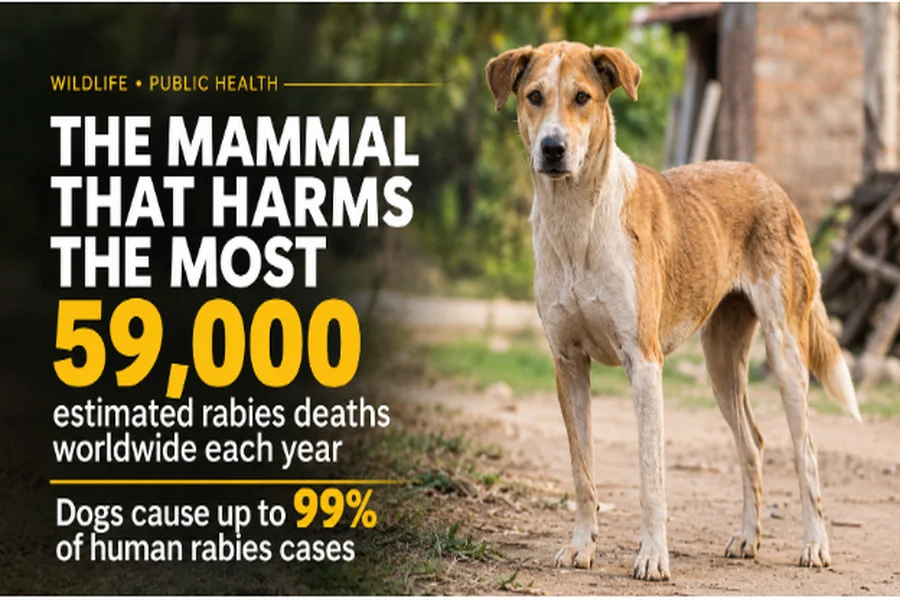
The mammal that harms the most humans every year is the domestic dog. The main reason is not bites alone but rabies, a virus that dogs pass to people through bites and scratches. The most widely used estimate, cited by the World Health Organization (WHO), is that rabies kills about 59,000 people a year, and that dogs are behind up to 99% of those human cases.
“Harm” can mean different things, though. Some mammals kill people by spreading disease. Others kill or injure people in direct attacks, like an elephant charging a farmer or a hippo tipping over a canoe. These are separate kinds of harm, and the numbers for them come from very different sources. This guide keeps them apart, so you can see which mammal is most dangerous in each sense and how much we really know.
What Mammal Kills the Most Humans Every Year?
Domestic dogs kill more people than any other mammal, almost entirely through rabies. No wild mammal comes close.
- About 59,000 deaths a year. This estimate comes from a 2015 University of Glasgow-led study in PLOS Neglected Tropical Diseases, and WHO used it in its 2018 rabies vaccine position paper. The study’s range runs from about 25,000 to 159,000 deaths.
- Most deaths happen in Asia and Africa. WHO’s Africa office puts their share at about 95%. India alone accounts for roughly 35% of global deaths, according to WHO.
- Children are hit hard. About 40% of rabies deaths are children under 15, WHO reports.
Rabies deaths are not the same as dog-bite deaths
A rabies death happens when an infected animal passes on the virus and the person does not get treatment in time. A dog-bite injury death happens when the attack itself kills, through blood loss or severe wounds. No one has a reliable worldwide count of the second kind. Most bites do not spread rabies, especially where dogs are vaccinated.
Why we can’t rank every mammal by total harm
Rabies deaths have to be estimated with models, because many happen in rural areas and are never tested or recorded. Wild animal attacks are counted country by country, in different years and in different ways, and injuries are recorded even less often. So no complete harm ranking of all mammals exists. The figures in this article are the best available records, not one comparable dataset.
How Do Dogs Cause So Many Human Deaths?
Dogs are dangerous to people mainly because they are the most common carrier of rabies where many people live near unvaccinated dogs.
How rabies spreads
Rabies is a zoonotic disease, which means it passes from animals to people. The virus lives in the saliva of an infected animal. It usually enters a person’s body through a deep bite or scratch. Licks on broken skin can also be a risk.
Once inside, the virus travels slowly along the nerves toward the brain. WHO says the incubation period, the time before symptoms appear, is usually 2 to 3 months. It can be as short as a week or as long as a year.
Why untreated rabies is so deadly
Early signs can look mild: fever, plus pain, tingling or burning where the bite happened. Once the virus reaches the brain and symptoms start, rabies is almost always fatal, according to WHO. There is no reliable cure at that stage.
The good news is that rabies is preventable if a person acts quickly after an exposure. Treatment called post-exposure prophylaxis (PEP) stops the virus before it reaches the brain. PEP means washing the wound well, getting a series of rabies vaccine shots, and, when needed, getting rabies antibodies. WHO says over 29 million people receive human rabies vaccine each year.
Why the risk is higher in some places
Rabies deaths are not spread evenly around the world. They are concentrated where:
- many dogs roam freely and are not vaccinated,
- people live far from clinics that stock rabies vaccine,
- PEP is too expensive or hard to reach, and
- people may not know that a bite needs urgent care.
In much of the Americas, mass dog vaccination has largely broken dog-to-human spread. There, WHO says bats are now the main source of human rabies cases.
How dog-mediated rabies can be stopped
The most effective step is to vaccinate dogs, not just treat people after they are bitten. WHO calls mass dog vaccination the most cost-effective way to prevent rabies in people. The rabies groups behind the End Rabies Now campaign say vaccinating at least 70% of dogs in an area can stop the virus from circulating.
Culling (killing) stray dogs does not work well. WHO says it is not effective for controlling rabies, partly because new, unvaccinated dogs move into the empty territory.
WHO, the World Organisation for Animal Health (WOAH) and the Food and Agriculture Organization (FAO) back a global plan called Zero by 30. Its goal is to end human deaths from dog-mediated rabies by 2030.
Top 10 Mammals That Can Be Dangerous to Humans
Each mammal below is here because studies, government records or health agencies show it causes deaths or serious injuries, through disease, attacks or both. This is not a ranking by yearly deaths. Apart from dogs, no reliable worldwide death count exists for these animals, so the order is for reading, not scoring. For fuller profiles of each species, including behavior and habitat, see the guides at Animals Window.
| Mammal | Main type of harm | Where the best evidence comes from |
| Dogs | Rabies, bite injuries | WHO global estimates |
| Elephants | Direct attacks (often defensive) | Government records in India and Sri Lanka |
| Hippos | Direct attacks (territorial) | Regional studies; no solid continent-wide count |
| Lions | Direct attacks (sometimes predatory) | Tanzania field study |
| Tigers | Direct attacks (often predatory) | Indian government records |
| Bears | Direct attacks (mostly defensive) | Worldwide brown bear study |
| Wolves | Attacks, many linked to rabies | Global attack review, 2002–2020 |
| Leopards | Direct attacks near villages | Indian state and research records |
| Wild boars | Tusk and bite injuries | Worldwide fatality study, 2000–2019 |
| Monkeys | Bites, scratches, disease risk | WHO animal-bite data |
1. Dogs
Rabies makes dogs the most harmful mammal by far. Dogs also cause more bite injuries than any other animal: WHO says dog bites cause tens of millions of injuries a year, and in lower-income countries dogs account for 76% to 94% of animal-bite injuries. Children face the highest risk.
2. Elephants
Elephants kill people mostly in places where farms and villages press up against elephant habitat. An elephant may raid crops at night, and a farmer who tries to chase it away can be charged and trampled. Many attacks are defensive, especially when people surprise an elephant or come near a calf.
India has some of the clearest records. Government figures shared in Parliament show 629 people were killed by elephants in 2023–24, and about 2,869 between 2019–20 and 2023–24. Sri Lanka has also faced heavy losses: Reuters reported an average of 138 human deaths a year there since 2019. Both countries also lose hundreds of elephants each year to the same conflict.
3. Hippopotamuses
Hippos are plant-eaters, but they are fiercely territorial, especially in water. Attacks often happen when a boat drifts too close, or when someone on land gets between a hippo and the river. A hippo can overturn a canoe or bite with enough force to kill.
You will often read that hippos kill about 500 people a year in Africa. Africa Check traced this figure to outlets such as National Geographic and the BBC, but there is no published field study behind that round number. Real counts are local. For example, one study in Zambia recorded 65 hippo-related deaths between 2002 and 2008. Hippos are clearly dangerous, but their exact yearly toll is unknown.
4. Lions
Lions sometimes hunt people, especially where their natural prey is scarce. The best-known study, published in Nature in 2005, found that lions killed more than 563 people in Tanzania between 1990 and 2004 and injured at least 308. Many attacks happened during the harvest season, when people slept in fields to protect crops from bush pigs, and lions followed the pigs.
Outside a few hotspots like southern Tanzania, lion attacks are uncommon.
5. Tigers
Tigers are among the few animals that eat humans on purpose, rather than attacking only in self-defense. Most deaths today happen in India and Bangladesh, where villagers enter forests to collect wood, honey or food. Indian government data shows 110 deaths from tiger attacks in 2022, falling to about 82 in 2023, with Maharashtra state reporting the most.
6. Bears
Most bear attacks are defensive. A bear that is surprised, protecting cubs, or guarding food may charge. A 2019 study in Scientific Reports found 664 brown bear attacks on people worldwide between 2000 and 2015. The most common situation was meeting a mother bear with cubs, and half of the victims were doing leisure activities like hiking.
The same study found that attacks have increased over time, likely because both bear numbers and outdoor recreation have grown. Still, attacks are rare compared with the number of people who visit bear country.
7. Wolves
Wolves are much less dangerous than their reputation. A 2021 report from the Norwegian Institute for Nature Research found 489 victims of wolf attacks worldwide from 2002 to 2020, and 26 of these were fatal. About 78% of the victims were attacked by rabid wolves, mostly in Turkey, Iran, India and nearby regions.
In Europe and North America over the same 18 years, the report found only 2 fatal attacks. The researchers described the risk as above zero, but too low to calculate.
8. Leopards
Leopards live closer to people than most big cats. They often move through farms and the edges of towns, especially in India and Nepal, and sometimes attack people, including small children. In India’s Maharashtra state, records show 113 human deaths from leopard attacks between 2017 and 2022.
Conflict often grows when leopards lose natural prey or are moved from one area to another. In Maharashtra’s Junnar area, attacks increased after leopards were captured and released elsewhere.
9. Wild Boars
Wild boars, also called wild pigs, are often overlooked. A 2023 study in the journal Human–Wildlife Interactions documented 172 human deaths from wild pig attacks in 29 countries between 2000 and 2019, an average of about 8.6 a year. Most fatal attacks involved a single large male using its sharp tusks, and most victims were on foot in rural areas.
About half of the fatal attacks happened in India. Most were defensive, though the authors found a few cases that looked predatory.
10. Monkeys and Other Primates
Monkeys rarely kill people, but they cause many bites, especially where they are fed by tourists or raid homes and markets for food. WHO says monkey bites make up 2% to 21% of animal-bite injuries, and studies in India found them second only to dog bites.
Monkey bites can also spread disease, including rabies, so anyone bitten or scratched by a monkey should get medical advice.
Which Mammals Cause the Most Human Deaths Through Direct Attacks?
Leaving disease aside, elephants have the strongest evidence for killing the most people in direct attacks. India alone records about 600 elephant-related deaths a year, more than any verified yearly total for hippos, lions, tigers or bears. India keeps unusually detailed records and many African countries do not, so this is the best-supported answer, not a proven global ranking.
Three patterns stand out across the evidence for each animal above:
- Plant-eaters can be deadlier than predators. Elephants and hippos do not hunt people, but their defensive and territorial attacks likely kill more people than lions or wolves do.
- Most victims are rural people at work. Farmers guarding crops, people gathering firewood and fishers on rivers face far more risk than tourists.
- Attacks are rare overall. Even the highest counts are small next to the yearly toll from rabies.
What Animal Kills the Most Humans in the World?
Across all animals, the mosquito causes the most human deaths. Mosquitoes are insects, not mammals, so they are not the answer to the mammal question, but they help put the dog figures in perspective.
Mosquitoes do not kill by biting hard. They spread germs. Some carry the parasite that causes malaria, and others spread viruses such as dengue. Malaria alone killed an estimated 597,000 people in 2023, according to WHO’s World Malaria Report 2024. WHO says about 95% of those deaths were in its African Region, and most victims were young children.
That one disease kills roughly ten times more people than dog-spread rabies.
What Mammal Causes the Most Human Deaths in Africa?
In Africa, the mammal behind the most human deaths is again the domestic dog, through rabies. WHO’s Africa office estimates that dog-mediated rabies causes about 21,476 human deaths a year on the continent, far more than any recorded total for a wild African mammal.
The popular claim that hippos are “Africa’s deadliest mammal” only holds if you limit the question to wild animals and direct attacks, and even then the evidence is thin. Most African countries do not publish national counts of wildlife deaths, and some only record cases where families claim compensation.
What the wildlife records show
Where records exist, the most dangerous wild animal changes from place to place:
- Kenya: A study of claims to Kenya’s national wildlife compensation scheme found that snakes caused the most deaths (614). Among mammals, elephants caused the most (268), followed by hippos (119) and buffaloes (106). Crocodiles, which are reptiles, caused 210.
- Tanzania: Lions are the main threat in parts of the south (see Lions above).
- Zimbabwe: The national parks agency reports about 60 human deaths a year from wildlife on average over five years, according to TRT Afrika.
Human-elephant conflict
Across eastern and southern Africa, elephants are involved in much of this conflict, mostly through crop raiding. The harm runs both ways, because elephants are also killed in revenge. That is why conservation groups focus on fences, early-warning systems and land planning that keeps farms out of elephant routes.
Are Mammals More Dangerous Than Other Animals?
No. Mammals kill fewer people each year than mosquitoes, and fewer than venomous snakes, which WHO estimates kill 81,000 to 138,000 people a year. These estimates come from different years and methods, but the pattern is clear: the deadliest animals spread disease or inject venom, mostly in rural regions where treatment is hard to reach.
Mammals stand out for a different kind of harm. They cause most of the direct physical attacks that make headlines, and most nonfatal animal injuries, chiefly dog bites.
How Can People Protect Themselves From Dangerous Mammals?
Most harm from mammals can be prevented with distance, common sense and quick medical care after a bite.
Around wild animals
- Keep a safe distance from wild animals, even ones that look calm. Never try to touch or take selfies close to them.
- Do not feed wildlife. Animals that link people with food, such as monkeys, bears and wolves, are more likely to approach and attack.
- Stay away from mothers with young. A mother elephant, bear or hippo is far more likely to charge.
- Avoid riverbanks and shallow water where hippos live, especially at dusk and at night.
- Follow local rules and advice from park rangers or wildlife officials. They know which areas and seasons are risky.
- Stay away from any animal that acts strangely, such as a wild animal that seems unafraid or a dog that is unusually aggressive or confused. These can be signs of rabies.
Around dogs and pets
- Vaccinate pet dogs and cats against rabies. This protects your family and your community.
- Teach children not to approach unfamiliar dogs or disturb dogs that are eating, sleeping or tied up.
- Report free-roaming dogs that seem sick or aggressive to local authorities.
What to do after a bite or scratch
If you are bitten or scratched by an animal that could have rabies, act right away:
- Wash the wound with soap and running water for at least 15 minutes. WHO recommends this as the first step.
- Go to a doctor or health clinic as soon as possible, the same day if you can.
- Tell the health worker what animal it was and where it happened. They will decide whether you need rabies vaccine and other treatment.
Do not wait for symptoms to appear.
Frequently Asked Questions
Do dogs kill more people than lions?
Yes, by a wide margin. Dog-spread rabies kills tens of thousands of people a year, while lion deaths number in the hundreds even over decades in hotspots like southern Tanzania.
Are hippos more dangerous than elephants?
Not on the available evidence. Hippos are extremely dangerous at close range near water, but elephants share far more land with people in Africa and Asia. In Kenya’s compensation records, elephants caused more than twice as many deaths as hippos.
Can a vaccinated dog give you rabies?
A properly vaccinated dog is very unlikely to carry rabies, which is why mass dog vaccination is the main tool for ending rabies deaths. A bite from any animal whose vaccination status is unknown should still be checked by a health worker.
Final Answer
Dogs harm more humans every year than any other mammal, mainly by spreading rabies. Among wild mammals, elephants have the strongest evidence for the most deaths through direct attacks, though these deaths are far fewer and concentrated where people and wildlife share land.
No complete worldwide count of mammal-caused deaths and injuries exists, so every figure here is an estimate. What is certain is that rabies deaths are almost entirely preventable with dog vaccination and fast treatment after a bite. The mammal that harms the most humans every year is also the one whose harm is easiest to stop.

Welcome to natureanimalhub! I’m Anam Sattar, an AI Powered SEO, and Content Writer with 4 years of experirnce.
I help websites rank higher,grow traffic, and look amazing. My goal is to make SEO and web design simple and effective for everyone.
Let’s achieve more together!