

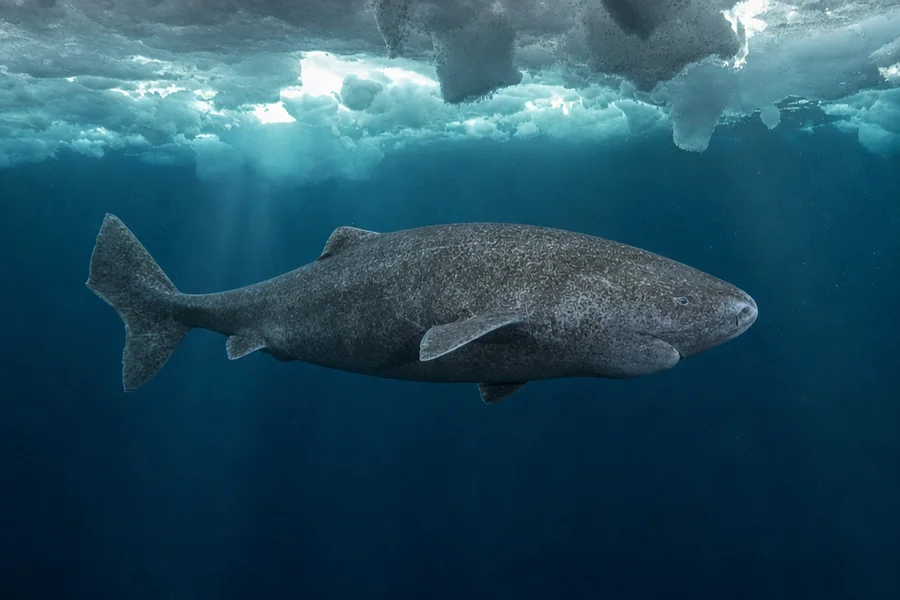
Some animals live for centuries. A clam from the North Atlantic reached 507 years, and Greenland sharks live for at least 272 years. Here are the longest-living animals that science knows, how researchers measure their age, and what these animals teach us about aging.
Most animals live for a few years or a few decades. A small number live much longer: some for more than two centuries, and a few seem to avoid aging in the usual way. These animals are not only a source of amazing facts. Scientists study them to learn why bodies age, and why some bodies age so slowly.
Here are the longest-living animals that science has measured, how researchers know their age, and what they teach us.
Which animal lives the longest?
The answer depends on what you count:
- The longest-living non-colonial animal on record: an ocean quahog clam (Arctica islandica), with a reported age of 507 years.
- The longest-living animal with a backbone: the Greenland shark, with a life span of at least 272 years.
- The longest-living mammal: probably the bowhead whale, which is estimated to live for more than 200 years.
- Animals that seem to escape aging: the “immortal jellyfish” and the tiny freshwater hydra, which age in a very different way from us.
1. Ocean quahog: 507 years
The ocean quahog is a clam that lives on the cold sea floor of the North Atlantic. It looks ordinary, but it holds the record among non-colonial animals: a reported maximum life span of 507 years. Researchers date these clams by counting the yearly growth lines in their shells, in the same way that you can count the rings of a tree.
Scientists now study the clam’s genes to learn why it lives so long. In 2025, a research team published the first high-quality genome of the species and called it “the longest-lived non-colonial animal species”.
2. Greenland shark: at least 272 years
The Greenland shark swims slowly through the cold, dark waters of the Arctic and the North Atlantic. It grows very slowly, and it can reach more than 5 meters in length. For a long time, nobody knew its age, because sharks have no bones with growth rings.
In 2016, scientists found a clever method. The center of a shark’s eye lens forms before birth and does not change after that. The team used radiocarbon dating on the eye lenses of 28 sharks. The results showed a life span of at least 272 years. The largest shark, at 502 cm, was about 392 years old, with a margin of 120 years. The same study estimated that these sharks reach adulthood at an age of at least 156 years, with a margin of 22 years. This makes the Greenland shark the longest-living vertebrate that science knows.
3. Bowhead whale: more than 200 years
The bowhead whale is a large whale of Arctic waters. Researchers estimate that it can live for more than 200 years, which probably makes it the longest-living mammal.
In theory, a large animal with so many cells and such a long life has a high risk of cancer. Bowhead whales do not seem to have this problem. When scientists read the bowhead genome in 2015, they found changes in genes for DNA repair, cell division, cancer and aging. These changes can help to explain how the whale protects its cells for two centuries.
4. Naked mole-rat: more than 30 years
The naked mole-rat is a small, wrinkled rodent from East Africa, about the size of a mouse. A mouse of that size usually lives only a few years, but naked mole-rats can live for more than 30 years.
Their most surprising feature is not the length of their life. In most mammals, including humans, the risk of death rises each year after adulthood. In a study of more than 3,000 records, the risk of death of naked mole-rats did not rise with age. A follow-up study in 2024, with twice as much data, found the same result.
5. The “immortal jellyfish”: a life cycle that runs backward
Turritopsis is a jellyfish smaller than a fingernail. An adult can change back into a polyp, the early stage of its life, and then grow up again. Scientists described this in 1996 and wrote that the animal can escape death in this way. This is why people call it the “immortal jellyfish”.
In the wild, these jellyfish still die from predators and disease. But in 1996, Turritopsis was the first animal known to return to its young stage after it reached adulthood.
6. Hydra: no signs of aging
Hydra is a tiny freshwater animal, related to jellyfish. In a four-year laboratory study, hydra showed no signs of aging: their death rates stayed very low, and their reproduction did not slow down. The researcher concluded that hydra can be “potentially immortal”. Later scientists debated this result, but hydra remains a favorite animal in aging research.
How do humans compare?
The oldest person with a verified age was Jeanne Calment of France, who lived to 122 years. That is a long life for a mammal of our size, but it is far from the Greenland shark or the ocean quahog.
| Animal | Longest known or estimated life span | How scientists know |
|---|---|---|
| Ocean quahog | 507 years | Yearly growth lines in the shell |
| Greenland shark | At least 272 years (largest about 392) | Radiocarbon dating of the eye lens |
| Bowhead whale | More than 200 years | Scientific age estimates |
| Human | 122 years | Birth and civil records |
| Naked mole-rat | More than 30 years | Records of animals in captivity |
| Turritopsis jellyfish, hydra | No fixed limit seen in the lab | Laboratory observation |
What do long-lived animals teach us about aging?
These animals are very different, but researchers see some common themes. Many live in cold water and grow slowly. Several have strong ways to repair DNA and to resist cancer. And some, like the naked mole-rat, keep their risk of death flat as they get older.
Scientists also study the molecules that cells use to make energy and to repair damage. One of them is NAD+. In a 2016 study in mice, researchers noted that NAD+ availability decreases with age, and a year of NMN, a building block of NAD+, reduced some signs of age-related decline in the animals. People are not mice, and the human studies are still small. In people, NMN raises NAD+ levels in the blood, but its effect on aging is not proven. A 2026 study also found that NAD+ in whole blood stays stable with age in humans, so the fall is a finding in tissues, not in blood. If you want to see what the human research has tested so far, this table of human NMN trials lists the studies, the doses and the results.
For now, the record holders of the animal world keep their secrets well. A clam that was alive before Shakespeare was born, and a shark that was possibly born in the 1600s, remind us how much there is still to learn about a long life.
Sources
- Gerhard GS, Allard JB, Kaniper S, et al. Genome assembly of Arctica islandica, the longest-lived non-colonial animal species. Animals (Basel). 2025;15(5):690.
- Nielsen J, Hedeholm RB, Heinemeier J, et al. Eye lens radiocarbon reveals centuries of longevity in the Greenland shark (Somniosus microcephalus). Science. 2016;353(6300):702-704.
- Keane M, Semeiks J, Webb AE, et al. Insights into the evolution of longevity from the bowhead whale genome. Cell Reports. 2015;10(1):112-122.
- Ruby JG, Smith M, Buffenstein R. Naked mole-rat mortality rates defy Gompertzian laws by not increasing with age. eLife. 2018;7:e31157.
- Ruby JG, Smith M, Buffenstein R. Five years later, with double the demographic data, naked mole-rat mortality rates continue to defy Gompertzian laws by not increasing with age. GeroScience. 2024;46(5):5321-5341.
- Piraino S, Boero F, Aeschbach B, Schmid V. Reversing the life cycle: medusae transforming into polyps and cell transdifferentiation in Turritopsis nutricula. Biological Bulletin. 1996;190(3):302-312.
- Martínez DE. Mortality patterns suggest lack of senescence in hydra. Experimental Gerontology. 1998;33(3):217-225.
- Robine JM, Allard M. The oldest human. Science. 1998;279(5358):1834-1835.
- Mills KF, Yoshida S, Stein LR, et al. Long-term administration of nicotinamide mononucleotide mitigates age-associated physiological decline in mice. Cell Metabolism. 2016;24(6):795-806.
- Yi L, Maier AB, Tao R, et al. The efficacy and safety of β-nicotinamide mononucleotide (NMN) supplementation in healthy middle-aged adults. GeroScience. 2023;45(1):29-43.
- Trętowicz MM, Scantlebery AML, Schomakers BV, et al. Human whole-blood NAD+ levels do not vary with age or lifestyle interventions. Nature Metabolism. 2026;8(6):1282-1290.
About the author: Nadosei Editorial writes plain-language guides on NAD+ and aging research for Nadosei, a company that sells an NMN supplement.

Welcome to natureanimalhub! I’m Anam Sattar, an AI Powered SEO, and Content Writer with 4 years of experirnce.
I help websites rank higher,grow traffic, and look amazing. My goal is to make SEO and web design simple and effective for everyone.
Let’s achieve more together!