

The global transition toward renewable power has been gaining incredible momentum over the past decade, driven by the urgent need to reduce carbon emissions and combat climate change. For years, scientists and engineers have worked tirelessly to push the boundaries of photovoltaic cells, attempting to squeeze every possible drop of usable power from the sun’s rays. Historically, the progress has been steady but incremental, with standard commercial modules hovering around the twenty percent mark. Today, however, we are witnessing a monumental shift as new solar panel technology achieves unprecedented energy efficiency levels. This massive leap forward is not merely a minor statistical improvement for laboratory environments; it represents a fundamental change in how we will capture, store, and utilize solar power in our daily lives. By breaking through longstanding thermodynamic limitations, these advanced photovoltaic systems are set to reshape the economic and environmental landscape of the entire planet. The implications of this breakthrough stretch far beyond the confines of academic research facilities. When high-efficiency solar tech enters the mass market, it alters the fundamental math of energy generation. Homeowners, massive corporate enterprises, and national grid operators are all standing on the precipice of a new era where clean energy is not just an ethical alternative, but the absolute cheapest and most reliable power source available. Understanding the mechanisms behind this innovation, and how it will cascade through our global infrastructure, is essential for anyone invested in the future of our world.
The Science Behind the Breakthrough
To truly appreciate the magnitude of this advancement, it is important to understand the historical limitations of traditional solar cells. For over half a century, the industry has relied heavily on silicon as the primary semiconductor material for photovoltaic panels. While silicon is abundant, reliable, and relatively inexpensive to process, it is bound by a physical law known as the Shockley-Queisser limit. This theoretical threshold dictates that a standard single-junction silicon solar cell can only ever convert about thirty-two percent of sunlight into electrical energy. The rest of the solar spectrum is either lost as heat or passes right through the material because the light photons lack the specific energy required to knock electrons loose.
The latest generation of solar panels bypasses this frustrating physical limitation through the ingenious use of tandem cell structures, most notably by integrating perovskite materials with traditional silicon. Perovskites are a family of highly flexible, lab-synthesized crystals that possess extraordinary light-absorbing properties. While silicon excels at capturing photons from the red and infrared parts of the light spectrum, perovskite materials are exceptionally efficient at absorbing high-energy blue and ultraviolet light. By layering a thin film of perovskite directly over a standard silicon base, engineers have created a “tandem” cell that effectively harvests a much broader cross-section of the solar spectrum.
This synergistic layering is the primary reason the new solar panel technology achieves unprecedented energy efficiency levels. In controlled testing environments, these multi-junction cells have recently pushed past the thirty percent efficiency mark, a milestone that was considered scientifically impossible for commercial-grade panels just a few years ago. Furthermore, early challenges regarding the rapid degradation of perovskite materials when exposed to moisture and heat have been largely mitigated. Modern encapsulation techniques and advanced chemical stabilizing agents now ensure that these high-efficiency panels boast a lifespan comparable to their traditional silicon counterparts. The manufacturing process has also been streamlined, meaning these complex layered cells can be produced using roll-to-roll printing techniques, keeping production costs astonishingly low while delivering maximum power output.
How This Impacts Residential Energy Use
For the average homeowner, the realization of next-generation solar cells translates directly into financial savings and enhanced energy independence. One of the primary barriers to residential solar adoption has always been roof space. Many homes simply do not have the square footage, or the optimal south-facing roof orientation, required to host a traditional solar array large enough to offset their entire monthly electricity usage. When solar panels become drastically more efficient, the physical footprint required to generate the exact same amount of wattage shrinks proportionally.
This space-saving attribute is a game-changer for urban and suburban neighborhoods. A family that previously could only offset fifty percent of their power bill due to a small or highly angled roof can now achieve complete net-zero status using fewer, higher-efficiency modules. Additionally, fewer panels mean fewer mounting racks, less wiring, and significantly reduced labor hours during the physical installation process. As a result, the upfront “soft costs” of transitioning to clean energy are minimized.
Beyond the strict mathematics of energy yields and installation costs, aesthetics also play a crucial role in residential adoption. Smaller, sleeker panels that blend seamlessly into standard roofing materials are much easier to design when efficiency yields are high. Homeowners no longer have to compromise the curb appeal of their property to generate clean energy. Furthermore, when these advanced systems are paired with modern residential battery storage solutions, households can achieve total grid independence. During the peak sunlight hours, the highly efficient modules rapidly charge the home’s battery reserves. Because they capture more energy in a shorter window of time, even regions with frequent cloud cover or shorter daylight hours during the winter months become viable candidates for profitable residential solar arrays. Ultimately, this technology democratizes energy production, placing the power of a micro-utility directly into the hands of everyday consumers.
Commercial and Global Environmental Benefits
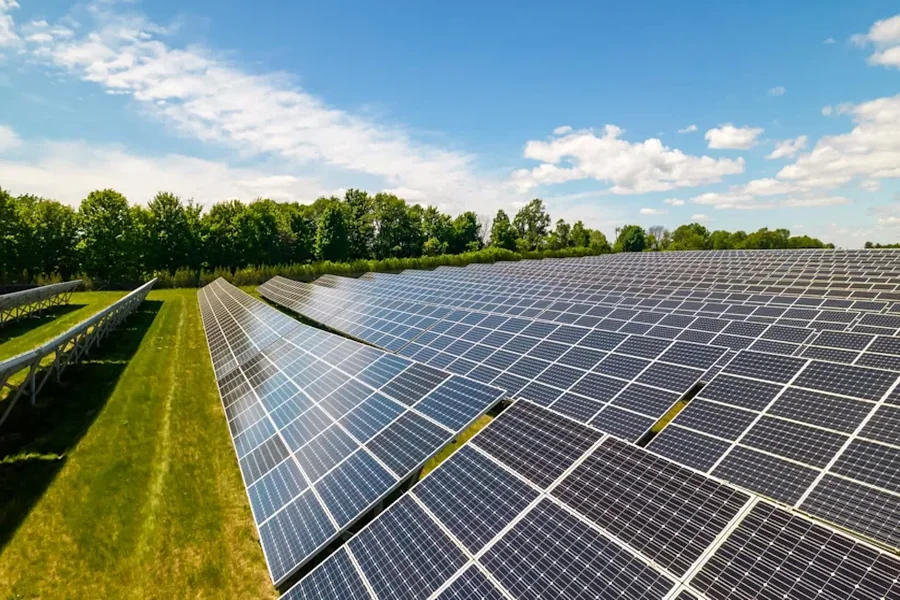
While the residential benefits are deeply compelling, the most profound impacts of this technological leap will be seen at the commercial and utility scales. Utility-scale solar farms require massive tracts of land, which has historically sparked intense debate regarding land use, habitat preservation, and agricultural displacement. Because these cutting-edge panels generate significantly more electricity per square meter, utility companies can now develop smaller solar farms that yield the exact same megawatt output. This high-density power generation preserves natural ecosystems and allows for the expansion of “agrivoltaics,” a dual-use system where crops are grown simultaneously underneath elevated, highly efficient solar arrays.
From a corporate perspective, the financial incentives are becoming impossible to ignore. Large-scale manufacturing plants, data centers, and multinational corporate headquarters consume vast amounts of electricity. As the Levelized Cost of Energy (LCOE) for solar continues to plummet well below that of coal, natural gas, and even nuclear power, massive commercial entities are aggressively pivoting toward green energy procurement. This is not solely for the public relations boost associated with Environmental, Social, and Governance (ESG) goals; it is fundamentally the most profitable business decision. Predictable, low-cost solar power stabilizes long-term operating expenses, protecting businesses from the volatile price fluctuations of the global fossil fuel market.
On a macroeconomic and environmental scale, this rapid advancement drastically shortens the Energy Payback Time (EPBT) of solar infrastructure. The EPBT refers to the amount of time a solar panel must operate to generate the equivalent amount of energy that was required to manufacture, transport, and install it. With higher efficiency yields, these new panels offset their manufacturing carbon footprint in a matter of months rather than years. As nations scramble to meet the aggressive carbon reduction targets set forth in the Paris Agreement, deploying the most efficient technology available is critical. It accelerates the decommissioning of legacy coal-fired power plants and limits the extraction of natural gas, offering a highly actionable and immediate pathway to achieving global net-zero emissions by the year 2050.
Final Thought
We are standing at a historic inflection point in the story of human energy consumption. The transition away from extractive, polluting fossil fuels is no longer a distant futuristic ideal; it is a rapid, ongoing reality driven by relentless scientific innovation. As new solar panel technology achieves unprecedented energy efficiency levels, the final remaining arguments against the viability of renewable energy are effectively dismantled. The combination of perovskite materials and advanced silicon structures has unlocked a new paradigm of high-density, low-cost power generation. By requiring less space, reducing installation costs, and generating clean power reliably across a wider variety of geographic climates, this technology ensures that a sustainable, zero-carbon future is entirely within our grasp.
FAQs
What makes these advanced photovoltaic cells different from older models? They utilize a tandem structure that layers synthetic perovskite materials over traditional silicon to capture a much broader spectrum of sunlight, significantly boosting energy output.
Will these highly efficient panels cost significantly more to install on my home? While the initial cost per panel may be slightly higher, the overall installation cost often decreases because you need fewer panels and less mounting hardware to meet your energy needs.
Are perovskite solar cells durable enough to withstand extreme weather conditions? Yes, recent advancements in chemical stabilizers and weather-resistant encapsulation techniques have extended their lifespan to match standard panels.
How does increased panel efficiency benefit the environment on a global scale? Higher efficiency drastically reduces the land required for massive utility solar farms and accelerates the timeline for panels to offset their manufacturing carbon footprint.
Can these newer panels generate electricity efficiently in cloudy or low-light climates? Yes, the advanced materials used in these panels are significantly better at absorbing diffused light and different wavelengths, making them highly productive even on overcast days.

Welcome to natureanimalhub! I’m Anam Sattar, an AI Powered SEO, and Content Writer with 4 years of experirnce.
I help websites rank higher,grow traffic, and look amazing. My goal is to make SEO and web design simple and effective for everyone.
Let’s achieve more together!